


This is an archived article that was published on sltrib.com in 2012, and information in the article may be outdated. It is provided only for personal research purposes and may not be reprinted.
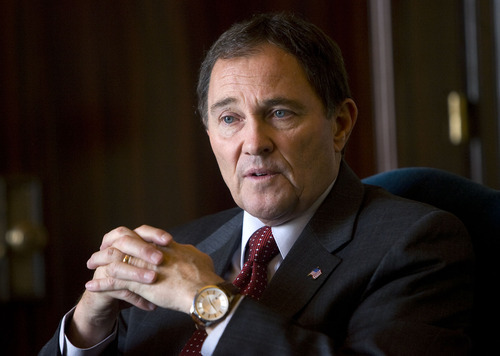
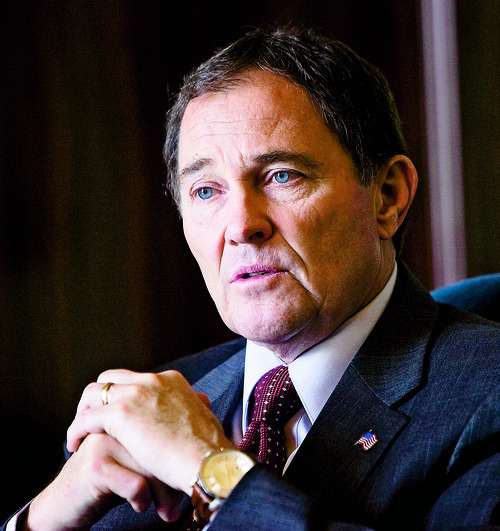
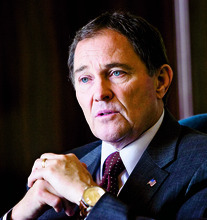
Gov. Gary Herbert signed legislation Friday demanding that Congress turn over roughly 30 million acres of federal land within Utah's borders — a move that proponents acknowledge could lead to a court battle.
"It's a difficult fight. This is the first step," said Herbert before signing the measure, "but it's a fight worth having."
Supporters of the effort contend the federal government made a promise to Utah and Western states to dispose of hundreds of millions of acres of federal land, just as it had done in states east of the Rockies.
But it never happened and now Herbert and others say the inability to control federal lands has hampered the state's economy. Herbert said that the director of the Bureau of Land Management has more control over the state than the governor.
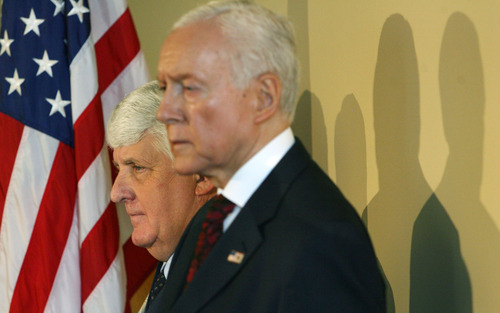
Sen. Orrin Hatch referred back to the original Sagebrush Rebellion, when several Western states passed similar laws, declaring state control of federal land. Hatch sponsored a bill in 1979 to liquidate federal holdings, but it never got a hearing.
The six-term senator said in an interview that what is different today is that federal regulations are even more onerous than they were then.
"It's gotten [to be] more federal intrusion, more federal refusal to allow us to decide our own destiny," Hatch said. "We're so completely overlorded with federal bureaucrats that we can't do the things we know we ought to do."
Hatch said there are vast oil, gas and oil shale resources that the federal government has refused to allow to be developed.
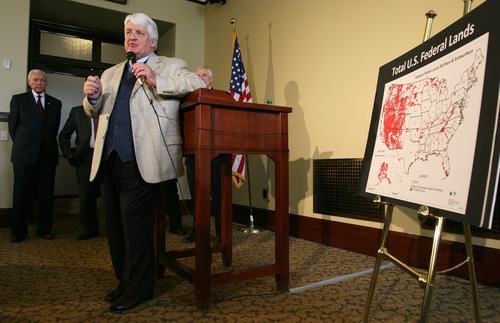
Rep. Rob Bishop said the federal government is paying $8.6 billion a year to manage federal lands, and isn't doing a good job of it.
"The state of Utah is willing to stand up and say to the federal government, we're willing to take responsibility for the state of Utah," he said. "The West is ready. It needs it. It's now time to change the way we've done things traditionally … because the way we've done things traditionally flat-out doesn't work."
Rep. Ken Ivory, the sponsor of HB148, said that it would cost the state $2.2 billion a year for Utah students to get up to the national average in per-pupil spending, and opening the public lands for economic development is the best way to achieve that.
But Steve Bloch, an attorney for the Southern Utah Wilderness Alliance, dismissed such arguments.
"It's outrageous that the governor is signing this plainly unconstitutional legislation that is not going to raise a dime for Utah school children and, if ever put into action, would close off public lands to Utahns and all Americans," Bloch said. "This is simply pandering to the far right in an election year."
Bloch said if Utah wanted to fund education it could look to raising its severance tax on oil, which is less than half of Wyoming's, and begin imposing a severance tax on coal.
HB148 demands that the federal government relinquish control of the federal lands by the end of 2014. National parks, military installations and American Indian lands are exempt from the demand, as are congressionally designated wilderness areas.
National monuments run by the National Park Service are also exempt, but the Grand Staircase-Escalante National Monument would be turned over to state control. Proponents argue there are trillions of dollars of coal to be mined within the monument.
Utah Democratic Party Chairman Jim Dabakis said the end result could be strip mining of coal, drilling for oil and condominium development inside the monument.
"That's exactly the kind of thing that would be allowed under this law," he said. "It's not going to be implemented, but it's even more terrifying, the thought that it might be implemented."
But Herbert said that Utah can manage its land appropriately.
"There's no desire from the people of Utah to take public lands and somehow rape and pillage and develop them inappropriately," he said. "We understand there are very pristine vistas that need to be preserved … We also recognize there are some public lands that ought to be developed."
Herbert said the bill gets the attention of the federal government and nudges it to discuss what the proper balance should be between the state and federal government.
The bill establishes a commission to plan the use for the newly acquired acreage. A study will also be conducted on the costs and benefits of state ownership of the land.
It is not explicit that the state would go to court if Congress fails to respond — that ultimatum was in another public lands bill that did not pass the Legislature — but all parties agree that litigation is a likely outcome.
"It depends on what happens in the election this fall. If this administration stays we'll probably end up going the litigation route," said Rep. Rob Bishop. "If there's a new administration in January, they might bring a new attitude and be more receptive."
Legislative attorneys and legal scholars have both said that Utah's claim to ownership of the federal land is almost certainly unconstitutional, since Congress has broad authority under the Constitution to manage its property and Utah disclaimed any rights to the land in its enabling act and in the Utah Constitution.
Sen. Mike Lee, who helped craft the legal strategy behind the state action before he was elected to the Senate, said there has never been a case directly challenging whether Congress should have disposed of the land.
Even if there was, Lee said, there is a policy discussion and political discussion about whether Congress should or can manage the land, given the overwhelming federal debt.
Other states considered similar legislation during their legislative sessions this year. Thus far, Utah is alone in passing it, although a bill has passed the Arizona Senate and is pending in the House.
Ivory said there will be an effort to work with other states to over the next year to get them on board.
"Of course it's helpful, it creates critical mass [but] we have a duty to our kids and a duty to the future of our state to go forward on the rights and promises," Ivory said, citing a Japanese saying: "If we all cross together it's not scary."
State Rep. Brian King, D-Salt Lake City, said he would be supportive of the state getting some of the federal lands back and working collaboratively with the federal government if there are areas that should be opened, but said the state's approach is taking a sledgehammer to a mosquito.
"I just don't think that any federal judge is going to look at this and say, 'That's a legal theory that has real merit,'" he said. "You're just asking to have the case thrown out, and that's what we should be hoping for in the sense it will cost taxpayers less than a long, drawn-out fight."