




This is an archived article that was published on sltrib.com in 2012, and information in the article may be outdated. It is provided only for personal research purposes and may not be reprinted.
Although Democrats are vastly outnumbered in the Utah Legislature, those in the Senate still managed to have as much success passing their bills as big-majority Republicans in the House.
Both groups passed 56 percent of the legislation that they introduced this year, according to an analysis by The Salt Lake Tribune. House Democrats were a tad behind, passing 55 percent.
But Senate Republicans passed a lofty 78 percent, far outdistancing the other groups. That came as the Senate overall passed three of every four bills that its members introduced, while House members passed only about half of theirs.
The wide House-Senate gap fueled squabbling during the final days of the Legislature, as House members complained the Senate was moving too slowly — leaving many House bills to die without a final vote before lawmakers adjourned March 8.
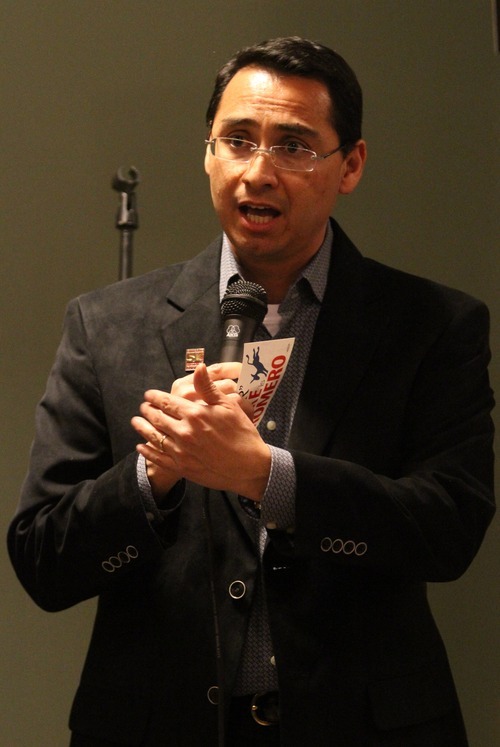
"We were going pretty slowly on many of those bills," acknowledged Senate Minority Leader Ross Romero, D-Salt Lake City, who also notes debate was controlled not by his party but by Senate Republicans, who hold a 22-7 majority there.
House Majority Leader Brad Dee, R-Ogden, said senators had their own priorities.
"It seemed like the Senate was more concerned with other things [than pushing House bills] those final days," such as negotiations to finalize the annual budget, which brought many breaks in floor action, said Dee. "But that's their prerogative."
House Minority Leader David Litvack, D-Salt Lake City, said some gamesmanship was involved.
"That last week, there was frustration on both sides of the aisle over here [in the House] about the speed with which the Senate was working .... So some of the typical games were played."
That includes the House — where the GOP holds a 58-17 majority — calling several recesses as it started to consider Senate bills, to send a message to the Senate to pick up the pace or see its own top-priority bills be delayed or killed.
However, the Senate continued to debate and vote on each bill twice (while the House generally debates bills just once) until the final day. The Senate also upset some House members by considering a few Senate bills on final days that are supposedly reserved for House bills.
Senate President Michael Waddoups, R-Taylorsville, defends the way the Senate spent its time, noting that the Legislature still passed more House bills than Senate bills — 269 to 209.
"They have a lot more members" 75 compared with 29, "so they had a lot more bills to work through. And this year, they had a lot of new guys over there who were all trying to show they were doing something" by introducing more bills, he said. "I think we did just fine. We were fair."
Romero said another factor contributing to the House-Senate gap was that many of the session's most controversial bills came from the House, requiring longer debate than the more nuts-and-bolts bills that senators tended to push.
"House members, by and large, were the ones proposing federal land bills that took a lot of time to discuss; bills on abortion; bills on sex education," he said.
Another factor holding down the House Republicans' bill-pass rate may be that they simply waited too long to get down to business. House GOP leaders were complaining in caucuses several weeks into the 45-day session that too many members had not finished drafting and introducing bills, while some committees had been canceling hearings for lack of bills ready to consider. That created a crush at the end.
Romero and Litvack, meanwhile, said outnumbered Democrats have learned that they must push their bills early and work on them year-round to have success. At the same time, the two praised GOP leaders for generally treating them fairly.
Waddoups said the numbers show that is true. "[Democrats] were working with us, and not trying to criticize or embarrass us. So we let them put up their bills and have hearings. If the bills are good, we pass them. We let them stand or fall on their merits," he said.
The Tribune analysis of bills (which excludes title-only bills introduced only as place-holders) also shows which members passed the most — or least — legislation. Lawmaker-specific lists on pass rates can be viewed here and the fate of their specific bills can be viewed here.
Most bills • Sen. Curt Bramble, R-Provo, passed 20 bills, and introduced 26 — both the most in the Legislature.
Sen. Lyle Hillyard, R-Logan, passed 16. Fourteen bills each were passed by Sens. Stuart Adams, R-Layton, and Wayne Niederhauser, R-Sandy. Rep. Don Ipson, R-St. George, passed 13. And Rep. Wayne Harper, R-West Jordan, passed 12.
Highest percentage • Fourteen legislators — 10 Republicans and four Democrats — passed all of the bills they introduced.
Senators on that list are the following: Kevin Van Tassell, R-Vernal (nine bills); Todd Weiler, R-Woods Cross (8); Pat Jones, D-Holladay (6); and Waddoups (2).
House members included: Jim Dunnigan, R-Taylorsville (10 bills); Jennifer Seelig, D-Salt Lake City (5); LaVar Christensen, R-Draper (5); Jack Draxler, R-North Logan (5); Evan Vickers, R-Cedar City (5); Roger Barrus, R-Centerville (4); Tim Cosgrove, D-Murray (3); John Mathis, R-Vernal (3); Dean Sanpei, R-Provo (3); and Mark Wheatley, D-Murray (1).
Most frustrated • Six members — four Republicans and two Democrats, all in the House — did not manage to pass any of the bills they introduced.
They included: Brian Doughty, D-Salt Lake City (five bills); Keith Grover, R-Provo (4); Craig Frank, R-Pleasant Grove, (3); Francis Gibson, R-Mapleton (2); Dixon Pitcher, R-Ogden (2); and Janice Fisher, D-West Valley City (1).
Two other members did not introduce any bills (beyond title-only placeholders): Rep. Susan Duckworth, D-Magna, and House Speaker Becky Lockhart, R-Provo. House speakers by tradition introduce few bills.
High-office candidates • The legislators running for higher office this year had bill-pass rates that were lower than the 62 percent average of all bills that passed.
Rep. Chris Herrod, R-Provo, is running for the U.S. Senate. He passed two of the nine bills he introduced, or 22 percent.
Rep. Ken Sumsion, R-American Fork, is running for governor. He passed four of the 10 bills he introduced, or 40 percent.
Rep. Steve Sandstrom, R-Orem, is running for Congress. He passed three of 13 bills, or 23 percent.
Two senators are running for Salt Lake County mayor: Romero and Ben McAdams, D-Salt Lake City. McAdams passed nine of 15 bills or 60 percent, while Romero passed one of eight for 13 percent. —
Online
Bill pass-rate by lawmaker: http://bit.ly/GK2BSE
Bill watch, by legislator: http://bit.ly/GKJ0Xt