


This is an archived article that was published on sltrib.com in 2012, and information in the article may be outdated. It is provided only for personal research purposes and may not be reprinted.
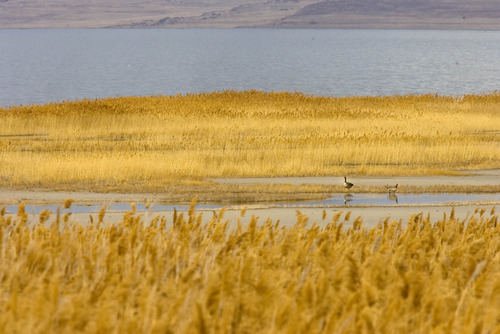
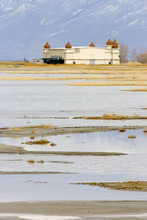
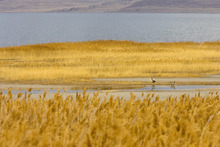
The Great Salt Lake is more than just a giant, scenic and sometimes stinky puddle. It also pumps more than $1.3 billion into the state's economy every year.That's the finding of a new report presented by the Great Salt Lake Advisory Council on Wednesday."Economics go hand in hand with the lake's health," said Lynn de Freitas, director of the Friends of the Great Salt Lake after hearing the findings. "It's very compelling."The report, previewed earlier this month by legislative budget makers, got a hearing Wednesday before the State Water Quality Board.It was part of a multidimensional approach to assessing how healthy the lake is for the wildlife and plants that depend on it, as well as the economic value of everything from salt and magnesium mining to waterfowl hunting, sightseeing and brine shrimp harvesting.About 75 miles long and 35 miles wide, the Great Salt Lake is the largest natural lake west of the Mississippi River. The remnant of a vast, prehistoric lake, it has no outflow and loses water only to evaporation.Too salty to support fish and many other types of wildlife, it is a factory for minerals and for brine shrimp and brine flies. An icon for the state, it also is well-known for having some of the nation's highest toxic methyl mercury levels and for the smelly air it exudes sometimes, usually during the spring.Leland Myers, chairman of the advisory committee and manager of the Central Davis Sewer District, highlighted the results of a scientific assessment of the lake's ecological resources, such as the quality of the waterfowl habitat, the mud flats and marshes. The report focused on four bays - Gunnison, Bear River, Gilbert and Farmington - and concluded that there are some trouble spots that need more attention to preserve their value in the future.Myers said the message was simple: "Don't expect to get good economies out of the state unless you protect the ecology."While many areas seem to be doing well, the report noted, the impounded wetlands and alkali knolls, or shrubby mud flats, of Farmington Bay are in poor health, as are the alkali knolls at Bear River Bay. In addition, there was too little scientific data on the open waters of the lake to really know how they are faring now."I think every single member of the Great Salt Lake Advisory Committee was surprised," said Don Leonard, who led the development of the economic analysis. "These are real economic impacts."President of the Utah Artemia Association, he noted that the first-of-its-kind study showed how the lake's economic benefits are woven together with its ecological health.The $1.3 billion in total economic output was based on an estimated $1.1 billion from the industrial sector, largely minerals; nearly $136 million from recreation; and nearly $57 million from brine shrimp aquaculture.In addition, about $375 million in paychecks and 7,706 jobs can be traced to the lake, he said.Leonard also noted several related benefits from the lake. One is the "passive use" value of $100 million, based on the lake's value for bird habitat and other geologic and ecological characteristics. Passive use, he said, is not tied to the direct economic uses of the lake, but instead it reflects "the value people place on simply preserving the resource."Another benefit is the use of the lake for sewer plant discharges which amount to an estimated $10 million to $59 million annually in avoided treatment costs. If the wastewater had to be treated to freshwater standards, costs would be significantly higher, Leonard said.He noted that the US Magnesium plant on the lake's southwestern edge is the biggest North American producer of the metal strengthening metal and alloy, and it is responsible for 14 percent of worldwide production.Leonard also pointed out that 99 percent of the brine shrimp and eggs harvested on the lake are shipped oversees, although the lake produces just 35 to 45 percent of the supply worldwide.Myers said the council's goal for this year is to develop a priority list for future research. But he added that the panel needs more funding and more authority to fully carry out its mandate."Without money and without power," he said, "you are [left] hoping people will listen to you."The Nature Conservancy provided funding for the studies through a $100,000 grant.fahys@sltrib.comTwitter: judyfutah —
Online • More on the lake's ecology, economy
O To see the reports in detail, go to the Great Salt Lake Advisory Council's Web page: http://www.gslcouncil.utah.gov and check the "activities" link.