



This is an archived article that was published on sltrib.com in 2012, and information in the article may be outdated. It is provided only for personal research purposes and may not be reprinted.
Utah is rushing to adopt a sage grouse-protection plan that can win federal biologists' approval and replace new national standards before those rules start hindering industrial development.
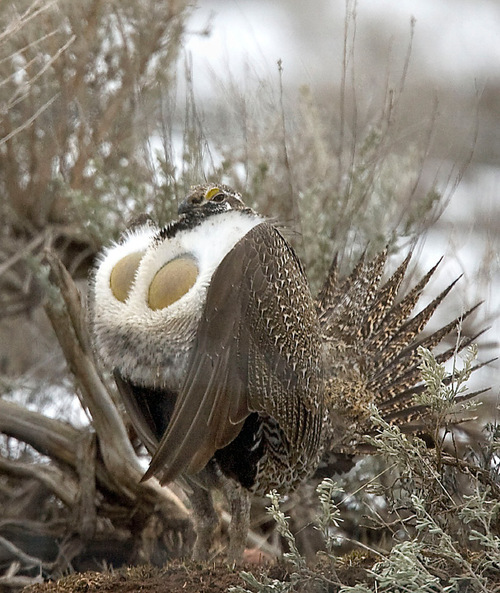
Utah Department of Natural Resources Director Mike Styler told a gathering of industry and conservation interests Thursday that Gov. Gary Herbert's administration will appoint a committee to negotiate a plan for approval by executive order within about three months. It will start with a recommendation by state biologists that there be no surface disturbance by mining, drilling or other industries within a mile of the breeding flats called leks.
"The goal here is to prevent a listing" of the bird as an endangered species, Styler said. The U.S. Fish and Wildlife Service in 2010 ruled that the imperiled Western range bird deserves such a listing — a move that would bring much stricter federal oversight of land uses — but funding was not available to complete it.
The agency will revisit its listing decision in 2015. In the meantime, the U.S. Bureau of Land Management has issued temporary guidelines that offer a three-mile buffer to leks.
Utah has 311 leks considered occupied, meaning they've been in use at least once in the past 10 years. They stretch from Rich and Box Elder counties in the north to San Juan and Kane counties in the south, according to the Division of Wildlife Resources. Historically, there were 442 known leks.
One potential way around the temporary rules is passage of a state plan that both the BLM and Fish and Wildlife Service agree will help prevent decline and extinction. State officials are looking to protect economic development, but their plan also must protect birds or federal officials may reject it.
Wyoming has crafted a plan that federal biologists like and, as a result, can opt out of most federal rules at least until a potential 2015 endangered-species listing.
Rancher Bob Budd coordinated that effort for Wyoming's governor. On Thursday, he came to Salt Lake City to advise the gathering at DNR headquarters.
"The state," he recalled, "took the future of the species in its hands and said, 'We want to do it, and we want to do it right.' "
That meant mapping much of central and southern Wyoming as core habitat where, by the governor's executive order with consent from federal agencies, special rules apply to industry. The plan focuses on about 84 percent of the state's grouse population, applying the effort in those areas where it has the greatest chance of success.
The rules within those core areas require a 0.6-mile buffer between a lek and, say, a gas well, and allow only 5 percent of the surface area within critical habitat areas to be disturbed.
The appropriate buffer zone will vary by state and likely needs to be larger in Utah, he said. That's because Wyoming has many more leks — 2,027 — and the buffers around many of them overlap to create solid blocks of protection.
Some industry executives, particularly bentonite miners, at first bristled at then-Gov. Dave Freudenthal's plan to adopt this plan, Budd said. Eventually, though, they recognized that protecting the birds and keeping them from the endangered list was good for business. Now many of them voluntarily reclaim old habitat destruction zones to help the cause.
Wyoming's plan alone won't prevent the listing, though. Budd said every state from the Dakotas to Washington, Oregon and Nevada must do its part. If the other states don't help and the bird lands on the endangered list, he warned, then the kinds of restrictions currently covering 24 percent of his state would apply to the 85 percent where grouse once lived.
In Utah, the fear of heavy federal regulation is mounting. Last week at the School and Institutional Trust Lands Administration board meeting, SITLA Associate Director John Andrews told trustees the birds pose an "existential issue."
SITLA manages certain state lands to maximize income earmarked for schools, and strict grouse-protection measures forced by an endangered-species listing could make some of its lands unusable.
Under protections sought in an Idaho lawsuit by the environmental group Western Watersheds Project — essentially a three-mile buffer — 14 percent of Utah would be off-limits in the event of a listing, Andrews said.
Styler said he and other administration officials will meet during the next week to appoint a committee of a dozen or more representatives from industry and interest groups to a planning committee.
Environmentalists aren't necessarily sweating the politics of those appointments, because the committee must devise a plan that works for federal officials or it won't count for anything.
"The Fish and Wildlife Service must approve it, and that's good enough for me," said Allison Jones, biologist for the Wild Utah Project. "They're looking out for the bird."
Twitter: @brandonloomis —
Draft of Utah's sage grouse protections:
One-mile buffer for breeding grounds in "priority" habitat.
Required biological consultation for projects within four miles.
Priority habitat, as-yet unspecified, to cover up to 80 percent of the breeding population.
5 percent surface disturbance maximum in priority habitat.