


This is an archived article that was published on sltrib.com in 2012, and information in the article may be outdated. It is provided only for personal research purposes and may not be reprinted.
Call it the fable of letting the camel's nose into the radioactive tent. It's the notion that, if the state sticks with its plan to allow blended radioactive waste to continue coming into Utah, then still more too-hot waste is sure to follow and Utah's ban on hotter waste will unravel.
That's the concern raised Tuesday by critics of a plan by the Utah Division of Radiation Control to let EnergySolutions landfill in Tooele County take as much as 40,000 cubic feet of blended waste each year while doing an in-depth study on whether the landfill can safely contain the stuff. That amount is 10 times the amount of blended waste the company has been importing in recent years, based on state figures.
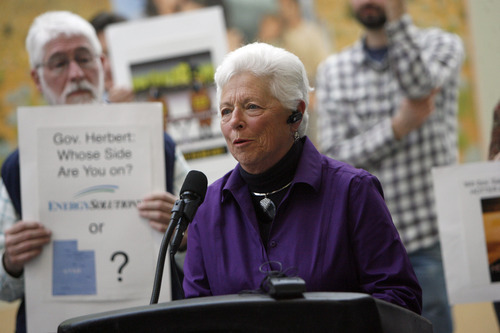
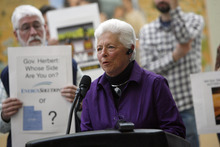
"This isn't what the citizens of the state of Utah wanted," said civic activist Claire Geddes, testifying before the Radiation Control Board.
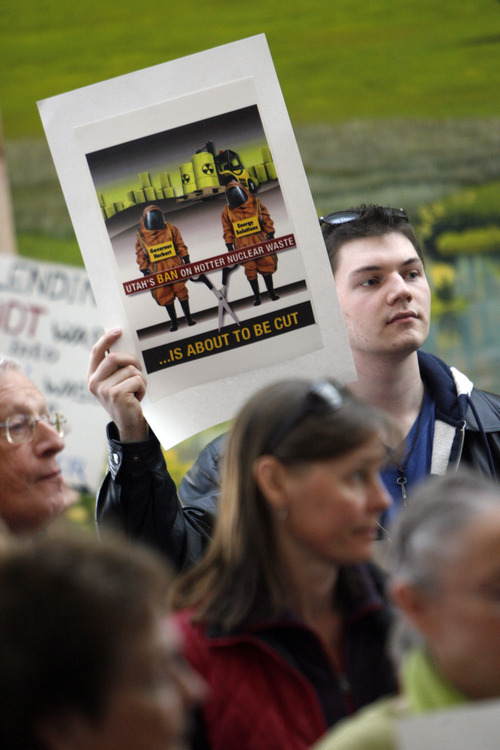
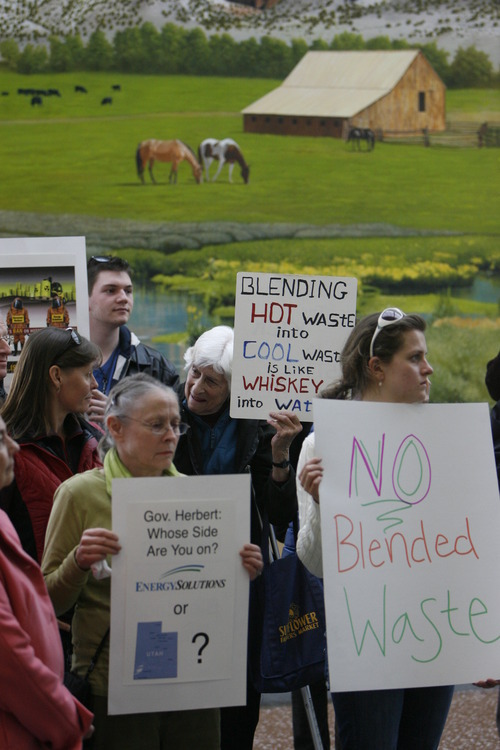
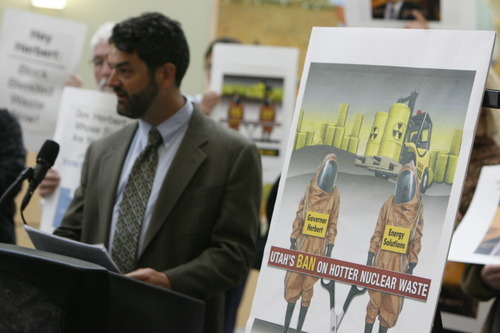
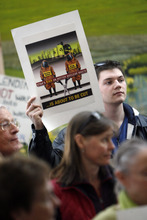
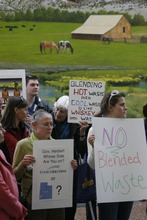
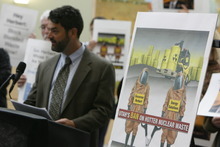
Geddes, like four dozen others who took part in a rally before the board's meeting Tuesday, said the new policy, in effect, violates the statewide ban on radioactive waste that exceeds Class A hazard limits. That ban was sought by former Gov. Jon Huntsman and enacted by state lawmakers in 2005.
"Unfortunately, Governor [Gary] Herbert appears poised to let EnergySolutions run this hot waste through a blender and then send it here," she said. "It's nothing more than a gimmick to get around Utah's ban on hotter nuclear waste."
Radiation Division Director Rusty Lundberg outlined for the board Tuesday the reasons behind his agency's approach to blended waste.
From a legal standpoint, the waste is classified after it is blended and before it comes to Utah, so the fact it once had higher hazard components is not relevant as long as it meets the state's Class A standard, he explained.
Lundberg, joined by state Enviromental Quality Director Amanda Smith, said in an interview Monday that protecting public health and the environment is the bottom line for regulators. And, consistent with that goal, is the regulators' plan to allow some blended waste while the company provides a technical analysis of the landfill's suitability for even larger volumes, they said.
"Those are ultimately our concerns," Smith told The Tribune. "Is the [EnergySolutions low-level radioactive waste disposal] cell constructed and engineered well enough to take care of this particular material into the future, and will taking large quantities change that at all?"
Blending, or down-blending as some call it, allows higher-hazard waste to be mixed with lower-hazard to create a blend that meets Utah's waste acceptance limit. That created an obstacle for the nation's nuclear power plants that lost their sole low-level disposal option nearly four years ago, which is around the same time industry began to promote the idea of blending.
At that time, industry estimates suggested that blending could deal with as much as 90,000 cubic feet of waste each year. It also has triggered separate studies by the state and the U.S. Nuclear Regulatory Commission of whether large quantities of this blended waste pose unusual hazards over the long term.
Lundberg said Utah has looked at key isotopes of the blended waste and concluded that it would potentially add about 19,000 curies of radiation to the site, a hazard well within the 70 million curies permitted in the EnergySolutions landfill cell where blended waste is slated to go.
The in-depth "site performance assessment" will not only ensure large volumes of blended waste would not be excessively hazardous, Lundberg said, but it also will apply new technical tools to check the site's safety features and their durability.
EnergySolutions' Tom Maggette emphasized his company is willingly updating its performance assessment even though the site already has been thoroughly analyzed and shown to be suitable not just for Class A waste but also for even the hottest low-level waste the state has banned.
He added that, were EnergySolutions to take all of the blended waste power plants make, the whole site would only be holding 2 percent of the radiation it is authorized to accept.
Blended waste "is Class A waste," said company spokesman Mark Walker. "We are not trying to bring Class B and C waste here."
The concerns raised by critics Tuesday were echoed several political leaders, including Rep. Jim Matheson, Salt Lake City Mayor Peter Corroon and County Councilwoman Jani Iwamoto.
"I don't understand why the Division would be putting the 'cart before the horse' in allowing the waste into the state before a site performance assessment has been completed," Matheson said in a Jan. 9 letter to Lundberg. "The practice of large-scale waste blending appears to be a back-door means to dispose of 'hotter' levels of radioactive waste in a state that has specifically decided not to take these hotter waste streams."
Twitter: @judyfutah —
Want to weigh in on blended waste?
The Utah Division of Radiation Control will accept public comments on the blended waste plan beginning Jan. 17 and continuing through Feb. 17.