



This is an archived article that was published on sltrib.com in 2013, and information in the article may be outdated. It is provided only for personal research purposes and may not be reprinted.
Weeks after returning from Iraq, where he and other Utah Marines were part of the bloody, chaotic ground invasion that secured Baghdad, Nick Lopez was on a flight to the Cayman islands with his family.
As he read a magazine article about the war he'd left behind, Lopez saw a picture of a small Iraqi girl with pink shoes in her father's arms, taken just after the family was caught in crossfire.
The top of the girl's head was gone.
"I started bawling," Lopez remembers. "I was inconsolable on the aircraft."
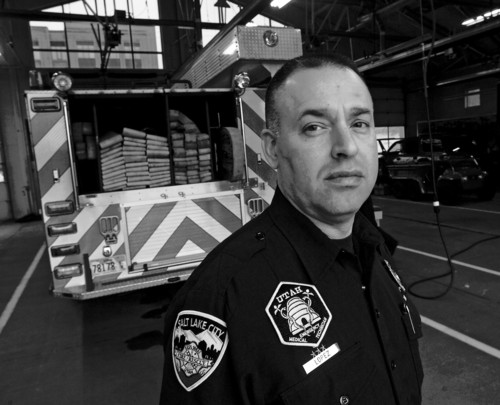
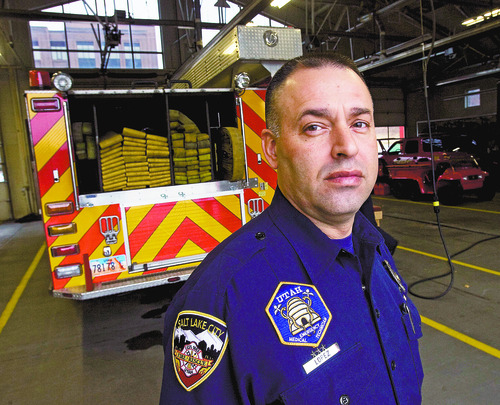
That episode in the spring of 2003 should have been a clue to Lopez, a Sandy native and long-time Salt Lake City firefighter.
But it took years, anger severe enough to doom his marriage, and a recurring nightmare for Lopez to acknowledge what the ground invasion, which began on March 19, 2003, had cost him.
"I was a first sergeant. I wanted to be sergeant major. I was damned if I was going to tell somebody I had PTSD (post traumatic stress disorder) early on," says Lopez, now 47.
The price of war, 10 years on, is still being exacted, even on those who were in Iraq only once and only for a few months. Fox Company of the 2nd Battalion, 23rd Marines, known as the "Saints and Sinners" because it is based in Salt Lake City and Las Vegas, was attached to the 1st Marine Division for the invasion. Lopez and the nearly 200 Marine Reservists of Fox company were home by late May 2003.
But going to war also left many soldiers with an appreciation for life, a sharper focus on what matters and above all, deep friendships with fellow fighters.
"I don't think there is a day that goes by that I don't think of the war," says John Worsencroft, who was 21 when he served under Lopez in 2003.
"There's something to be said for the experience," says Worsencroft, a Murray native who is now a doctoral student in history at Temple University in Philadelphia. His focus is on military and society.
"It's all the clichés you can imagine, but at the same time, it was a very exciting experience, a very frightening experience," says Worsencroft. "It was both formative and transformative. I don't think I'm the same."
—
'We took a fair amount of life' • As the 10th anniversary of the invasion, the messy April fight for Baghdad and the early months of war approach, many veterans are reflecting on that tense time.
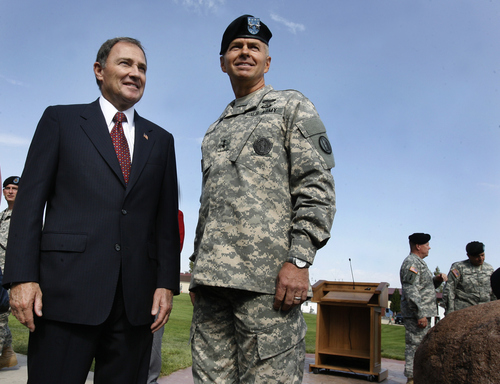
Maj. Gen. Jeff Burton, promoted to adjutant general of the Utah National Guard last fall, led the 1457th Combat Engineer Battalion into Baghdad in May.
"Things were still smoking," recalls Burton. "The people were overjoyed to see us. They pretty well hugged us in the streets. Unfortunately, that didn't last long."
Top military brass made the mistake, he says, of removing mid-level managers who were vital to keeping the Iraqi government and military working. It only compounded the chaos and created animosity, he says.
Burton left Utah with 450 soldiers and had another 200 assigned to his command while in country.
Working with Vietnam-era flack vests and 1980s vehicles that lacked armor, the soldiers dismantled roadside bombs and helped recover bodies, body parts and the injured in buildings that were attacked. They were among the first on the scene when a suicide bomber struck the United Nations compound in August, killing 22 and wounding more than 100.
At one point, the soldiers of the 1457th were charged with rounding up animals that had escaped the damaged Baghdad zoo, even as they were under fire.
"There were lions, tigers, bears, hyenas running all over the place," Burton recalls. They killed donkeys back at the zoo to lure the animals back into their cages.
The 1457th's "fairly miraculous" survival — no deaths and only seven injuries — fed into a myth in LDS circles. Burton at one point publicly refuted a falsehood-riddled email that called his soldiers modern-day "Stripling Warriors," as described in the Book of Mormon.
Burton says that although anger and broken marriages have been common among his soldiers, only a handful were so debilitated that they cannot work. He still hears from stressed soldiers.
"One of my soldiers called (recently) and said, "We took a fair amount of life.' This particular soldier is still struggling with that."
Says Burton, "When someone is trying to kill you and you have to kill them, it's not something you're prepared for."
—
'It changes your perspective' • Michael Schoenfeld, a captain and platoon commander at the time and now a major and commander of Fox Co., figures that 80 percent of the company left the Reserves within 18 months of returning from Iraq.
Many no longer could hold a firearm. "It was too difficult for them," says Schoenfeld, who lives in Clearfield and is a policy analyst for the Federal Reserve.
One of the Marines, Walter Smith, pleaded guilty to second-degree manslaughter for the 2006 drowning of the mother of his two children in Tooele. He initially claimed he found her dead in a bathtub, but confessed months later at the Veterans Affairs medical center in Salt Lake City. He was given a term of one to 15 years in the Utah State Prison.
Among the horrors Fox Co. suffered was the early loss of Staff Sgt. James Cawley, who was killed when a Humvee driver, awakened and in a rush without night-vision goggles, ran over his fox hole.
Cawley, killed on March 29, was Utah's first fatality in Iraq, but its second of the war. Army Chief Warrant Officer John Daren Smith died Feb. 25 in Kuwait when the Black Hawk helicopter he was piloting went down in a sandstorm. Altogether, 41 service men and women from Utah or based in Utah died in the Iraq war.
Cawley was Fox Co.'s only fatal casualty; the unit was highly decorated with Purple Hearts and other medals.
Schoenfeld believes every warrior comes back with some level of PTSD: "You can't take war out of your memory." But one of the most lasting effects for him is the way he looks at the world.
"It changes your perspective on what's important and not important," he says, recalling that his Marines had to sort through Army trash to find food during the last week of their 400-mile trek to Baghdad. They had no armor, and were in canvas-covered trucks.
Like fellow Marines Worsencroft and Lopez, Schoenfeld says it's difficult to feel comfortable among civilians at times.
"I have a hard time connecting with people I meet and work with and I don't know if that will ever go away," he says.
—
'We didn't make a mistake' • Lu Lobello is on a mission.
Empowered by his continuing friendships with Fox Company Marines — helped considerably by social media such as Facebook — he's on a campaign to eradicate terms such "wounded warrior," and disability labels such as PTSD or moral injury, the term for those who suffer because they took human life.
"I would start filling their heads with the good propaganda," says Lobello, originally from Las Vegas and now in law school in San Diego. Instead of feeling like victims, combat veterans would know that they were only doing the job their nation asked of them.
"I'm trying to change the national discourse," he says.
Lobello last year finally located two Iraqi women, now living in the Los Angeles area, who survived when Fox Co. shot up their car as it hurtled through a Baghdad checkpoint on April 8, 2003. The men in the Kachadoorian family died that day.
The survivors are his friends now, but Lobello insists he did not need to apologize.
"We didn't make a mistake. We purposely meant to shoot them. But our purpose was to kill the enemy," says Lobello.
"They understood that I was just doing my job and that they were casualties of war."
—
'My dreams haven't gone away' • Lopez, who was promoted to sergeant major before his retirement in 2010, has long since "manned up" and gone to therapy. "I'd had enough of the attitude that a Marine can't be human," he says.
It was only last fall, when he saw the 2010 documentary "Severe Clear, This is War," that he realized why he flipped out on the plane to the Cayman Islands.
It was because that wasn't the first time he had seen the little girl in pink shoes; he remembered driving by, witnessing the carnage.
But it's his own role in inflicting hurt on civilians that haunts him.
Also on April 8, 2003, Lopez and his team of 25 to 30 Marines took out a white car that hurtled through a wire they'd just strung to keep civilians out of a Baghdad neighborhood.
"We'd already shot up one vehicle, killing two adult males and wounding two others at our site," he recalls. "We all thought they were attacking us. We turned our guns. I put 20 rounds through the windshield."
The driver and a young woman in the back were dead. His Marines rushed in. One sat in a pool of blood, cradling a woman as she died, and two other Marines clamped off the bleeding arteries of a boy who appeared to be 13.
The one walking survivor, a woman, was in Lopez's face, screaming, crying, pointing to her son.
And that's the woman who, in the decade since, has revisited Lopez hundreds of times as he sleeps.
"Time after time, three or four times a month...this woman is crying and screaming. My dreams haven't gone away."
Twitter:@Kristen Moulton Galleries of photos showing memorial services and funerals of Utah's service men and women, photos of those who died, of their departures and homecomings and photos taken by a Tribune photographer can be found at: