


This is an archived article that was published on sltrib.com in 2013, and information in the article may be outdated. It is provided only for personal research purposes and may not be reprinted.
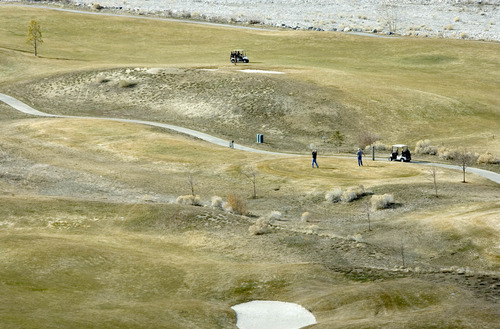
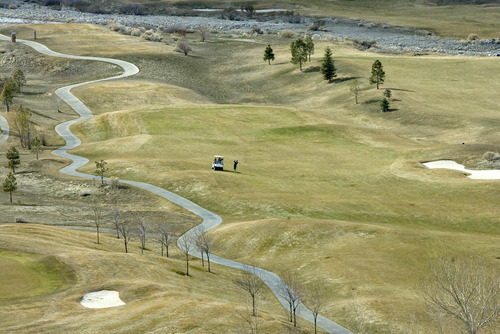
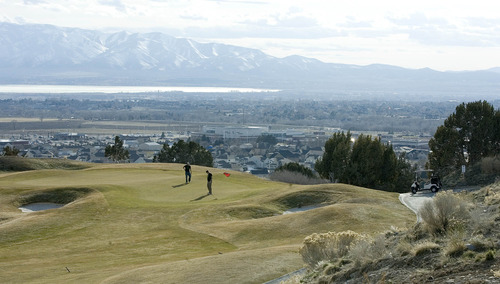
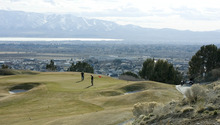
Cedar Hills • Rolling green hills, sand traps and pristine views once meant dollar signs for municipalities.
But now, with scores of golf courses crowding the state, some critics are saying the once-lucrative notion of a municipal course has become a financial sand trap even Mike Weir with his best pitching wedge couldn't escape.
With millions of taxpayer dollars being bagged faster than grass in an industrial mower, many question whether cities today can afford to create and run their own golf courses.
—
Money pit • In 2001, Cedar Hills, a city of 10,000, narrowly voted for a taxpayer-owned golf course. Since then, the golf course has not made a profit. Financial data show it has lost nearly a half-million dollars each year since 2004 or about $4.3 million in operational costs and general bond obligation. In trying to make the project successful, city leaders have spent nearly $10 million.
In an attempt to be more transparent and shed Cedar Hills' controversial past management of the golf course, the City Council recently opened up its budget to amend it. City Councilwoman Jenney Rees said taxpayers now will clearly see the city's money trail.
"There is not any time, in our eyes, that the golf course is going to be profitable and not in need of a subsidy," she said.
Roy Van Tassel of the Utah Taxpayers Association says an analysis shows it's "very clear municipal golf courses lose money" and cities "shouldn't be in the business of business."
Van Tassel said the first step is to stop the city from bleeding money. "The longer the city operates it, the more the taxpayers take [the cost] on the chin."
—
Hole in one • While Cedar Hills hasn't seen the projected success, others have shown that getting started 30 years ago helps. Smithfield's Birch Creek Golf Course — noted by Golf Digest as one of the nation's best municipal courses to play — finished with about $54,000 in the black in 2012.
But with three public golf courses in Cache Valley, Smithfield Mayor Darrell Simmons says competition is still fierce for the 30-year-old course, and it's similar to running a farm: good weather — an uncontrollable variable — directly affects business profits. Sound money management and frugality helps, though.
Simmons says the course has been kept afloat by rarely buying new equipment if it can be bought used.
Cedar Hills, however, recently said repairing its carts would be too costly and instead is leasing new ones. At the first of the month, two semi-trailers delivered more than $20,000 worth of new golf carts.
In Salt Lake City, any new equipment would have been funded from the city's golf enterprise fund, which is maintained with greens fees from the city's nine public golf courses alone and has received no taxpayer money since at least 1920, according to city spokesman Art Raymond.
"Being in the business of golf is a question many cities continue to ask themselves," Raymond said, just like parks or trails that don't bring in revenue but are wanted by residents.
While some cities can't function without selling to the private sector, Salt Lake City has been able to find a balance.
"We are able to do it without creating an additional burden to taxpayers, and that makes it a success to us," Raymond said.
Salt Lake County, though, hasn't seen as much good fortune.
Salt Lake County Chief Financial Officer Darrin Casper said that as recently as 2011 the countywide golf-course system subsidized courses with $1.4 million in tax revenues due to the recession. In 2013, the county plans on all six of its golf courses to break even on annual operational costs. It does, though, subsidize a portion of the courses' bonded debt.
—
Late to the game • Cedar Hills didn't start its golf course until the early 2000s, nearly a decade after an explosion of course construction throughout the state already had leveled off and demand began to wane.
Initially, a private developer planned to build and pay for the golf course, but those plans fell through. Mayor Brad Sears, a manager with a real estate development company, decided to take over the venture. Sears said in 2003 that not only would the course make money, but its tax revenues would help subsidize other city services.
After four years of increasing debt and no option for calling a mulligan, the city scrambled and invested an additional $700,000 to restructure the golf course to create 22 lots for homes. Five years later, the city has yet to sell a single lot.
But instead of attempting to sell the course, the city kept investing.
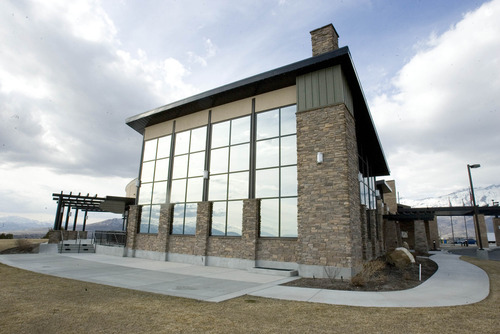
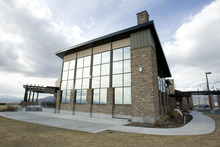
The city has paid a total of $9.8 million in taxpayer funds to continue to improve the course — from a new clubhouse replete with a PR firm to promote its lunch counter, pro shop and use for wedding receptions and as a community recreation center.
Earlier this month, new Finance Director Charl Louw urged the city to clean up its bookkeeping, which did not clearly show how much the city had to spend to cover its debt on the golf fund.
"It's just not a really good way to manage any fund," Louw said at a recent public hearing. "You need to have a realistic approach."
Councilman Scott Jackman said it will be nice to put the hot issue of the golf course behind.
"We definitely made a mistake," he said, "and we will definitely be better off moving forward."
cimaron@sltrib.comTwitter: @CimCity —
Find out how much your city subsidizes it's golf course:
- In the local government reports box click on municipality -> financial reports
—
Money spent on the golf course:
$6.4 for initial golf course general obligation bond.
$2.7 million in impact fees for clubhouse/community recreation center
$700,000 to reconfigure golf course for St. Andrews Estates.
Total Spent:
$9.8 million so far.