


This is an archived article that was published on sltrib.com in 2013, and information in the article may be outdated. It is provided only for personal research purposes and may not be reprinted.
Drug companies have paid Utah doctors $25.8 million since 2009 for research, consulting, travel and entertainment — a common practice, the scope of which is only now becoming clear and causing uneasiness in medicine.
That's the state's share of over $2 billion in payments nationally, according to the latest update to ProPublica's "Docs for Dollars" database, the largest repository of these payments.
Payments to Utah have grown six times in four years, and that only spans 15 manufacturers that account for 47 percent of the U.S. drug market.
Such payments have been secret for decades. But in recent years drug makers started disclosing them, some as a result of legal settlements.
Federal law requires all manufacturers to publicly report such data starting in 2013, an effort by the Obama administration to expose potential conflicts of interest. Research has shown such payments can influence doctors' treatment and contribute to higher medical costs as patients are steered to pricey, brand-name therapies.
"Industry ties don't necessarily mean that a physician is practicing bad medicine or making biased decisions," said Aaron Kesselheim, a doctor and assistant professor of pharmacoepidemiology and pharmacoeconomics at Harvard Medical School.
"But if a physician is recommending a certain procedure, say, or a certain expensive brand-name drug, then knowing a physician has a lucrative connection to the manufacturer of the device or drug may weigh into a patient's decision to accept the physician's recommendation or perhaps seek a second opinion," he said. "Making this information available and user-friendly is extremely important."
—
Industry funding research. • In Utah, ProPublica's data also spotlight a multimillion dollar industry of contract research organizations, or CROs, private companies that drug makers pay to test their drugs.
Among them is CRI LifeTree Research, which has received at least $3.4 million in drug company payments since 2009, according to ProPublica.
Co-founder Lynn Webster, an anesthesiologist, is listed as having received the single largest payment in the state: $1,687,771 from Cephalon, a big maker of pain medications. Only three other doctors in the country received more from Cephalon.
Nationally, Webster is among the top 50 for single largest payments received, behind marquee hospitals, such as the Mayo Clinic, Cleveland Clinic and Duke and Harvard Universities.
A nationally recognized expert in pain management, Webster is under investigation by the U.S. Drug Enforcement Administration, which is looking into opioid overdose deaths of patients of his former pain clinic. A Senate Committee is probing his financial ties to Big Pharma.
Webster no longer sees patients, but serves as a medical director at LifeTree's South Salt Lake location. Research payments to him cover overhead and other costs, including his salary as a lead researcher, he said.
"Research inevitably leads to better education, better systems and better therapies — things that are indispensable for medical advancement and quality care," he said.
At Salt Lake City-based Foothill Family Clinic, primary care physician and obstetrician Shane Christensen conducts industry trials on contract through the CRO J. Lewis Research. He was paid just over $756,000 by two drug companies between 2010 and 2012.
The payments cover overhead, seven full-time research coordinators, 13 sub-investigators and stipends for participants, he said. He said he understands the large payments may leave some with a negative view of the drug industry, but adds the costs of conducting trials that meet federal regulatory standards add up fast.
"But we have the safest drugs," he said. "Everybody wants the advancements of medicine. The dichotomy is, that if you don't do research, (the drugs) might harm you."
Christensen said he likes that the work puts him on the front end of medical advancements that may help his patients. But participation in any study is "a personal choice," he stressed.
"We spell it all out. There's informed consent," he said. "Some people are totally interested and glad to get on a study. Other people would never, ever do a study and use the 'guinea pig' reference.
Rules on payments are stricter today than the days when drug companies wined and dined doctors, said Derek David Muse, a family doctor and part-time researcher for Jean Brown Associates, a CRO in Millcreek with 17 open trials, most of them for vaccines and pain medications.
About 25 percent of his income comes through research, Muse said. Often his clinic is one of several sites contributing to a study.
"Each one is reimbursed depending on how many patients we enroll," he said. "We have a certain time frame to enroll patients and we only get paid a partial amount if a patient drops out."
—
Reasons for skepticism • Industry-funded research by CROs fill a need by helping to bring to market new life-saving drugs, Kesselheim said.
But clinical trials carry risks, including serious harm, including death. And patients often enter them thinking mistakenly they'll be cured.
And there are reasons for skepticism about the research results, he adds. There are "compelling" data showing pharma-funded trials are more likely to have positive outcomes than independent, or government trials, he said.
This can be due to the statistical approach and other quirks in the study's design that bias the results, not necessarily because of fraudulent practices, he said.
Eliot Brinton, an internist and endocrinologist who recently left University Hospital and Clinics to pursue industry-sponsored research, agrees people should be wary of "research mills." Drug companies control which of their self-funded studies to publish and some have hidden negative results, giving doctors a skewed view of the risks and benefits of a drug, he said.
But the medical community has gotten better at imposing checks and balances, he said. Studies that aren't registered with the government at http://www.clinicaltrials.gov aren't generally published by high-ranking scientific journals, Brinton said. And surveys have shown doctors place less faith in industry-funded trials.
Brinton received two of the single largest payments in Utah, both in excess of $85,000, for promoting drugs by GlaxoSmithKline, ProPublica's database shows. He describes the lectures as educational and based on science.
"I love the science and I love to teach. And doctors are glad to better understand the drugs and how to use them. I'm careful not to act as a cheerleader," he said. "If I'm a shill for the drug company I lose my integrity and integrity is really all I have to offer my patients and the drug companies."
Brinton said he retired as a speaker for GlaxoSmithKline's diabetes drug Avandia "because I was concerned about the science."
Last year Glaxo paid $90 million to resolve allegations by federal prosecutors that it misrepresented the drug's safety, including cardiovascular risks. Brinton said he served as an expert witness at trial, testifying against Glaxo.
—
The rise of the CROs •In the 1980s, most clinical trials were done at academic medical centers, said Jean Blackburn, a former obstetrics nurse who now owns Utah-based CRO Advanced Clinical Research. It received just over $1 million for research in Utah between 2010 and 2012, ProPublica data shows.
But at the academic centers, legal and financial red tape slowed the trials' progress, frustrating drug companies that wanted to get products approved for the market, she said.
Industry's next step was the doctor's office-based trial model, which was followed by the development of the CRO, said Blackburn, who moved into the research industry in the 1990s. Her company has facilities in West Jordan, Boise, Idaho and Cleveland, Ohio.
She believes the CRO model makes sense because it presents fewer ethical conundrums — trial participants are not patients.
"Nobody is coming to us for care, they are coming to us to participate in a specific type of trial, so we don't have any of that conflict of interest," she said. "It's always something (doctors) have to think about in private practice. Patients look up to you for guidance, so doctors have to be very, very careful that they don't cross any line."
The portion of payments paid to contracted physicians is typically 10 percent, she said. More than 50 percent funds office personnel, and the rest covers expenses such as recruitment, overhead and outside lab work.
After drugs are approved, "in the real world, stuff happens," she said. "It started with phen-fen and the heart valve issue, and then Vioxx and Avandia," she added, referring to drugs later found to have hazardous side effects.
Industry-funded trials can uncover problems with drugs, she said. "So I think industry has definitely paid big attention to this now. There are far-reaching effects and often there is no way you can foresee this in smaller trials."
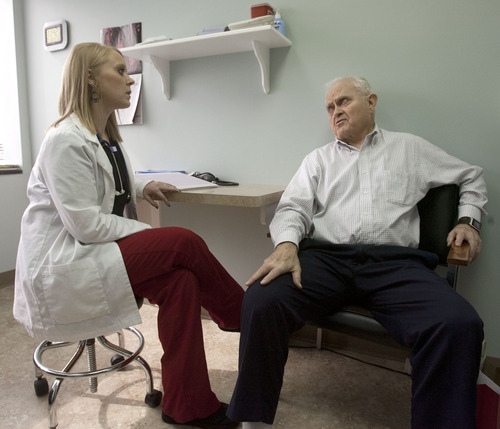
MarLynn James, 79, is participating in an Advanced Clinical Research study of a weight loss medication in West Jordan. A retired professor of physical chemistry who lives in Cedar Hills, James said he had only a cursory understanding about how the trials work, but felt well-informed about possible risks.
The double-blind study has James taking daily medication — which may be a placebo — and making lifestyle changes, such as increasing exercise and documenting what he eats. Since September, James said, his weight has dropped from 195 pounds to 179.
"Of course I don't know if the difference is the drug or the other things I'm doing," said James, who will be monitored over a period of four years. "My only problem now is that my belt is too long." —
Read more about Dollars for Docs
Pro Publica, an independent, non-profit newsroom, compiled two million records totaling $2 billion in payments from 15 pharmaceutical companies to health professionals nationwide. Read an explanation of how it assembled the database and its national overview story. —
What is a clinical trial?
Trials test new drugs and medical devices on humans after they've been government approved as safe and effective in lab and animal tests.
Phase I studies focus on safety. These tests can last several months and usually involve a small number of healthy volunteers, 20 to 100, who are generally paid to participate. The studies investigate side effects at different dosage levels. About 70 percent of experimental drugs pass this phase.
Phase II studies test the effectiveness of a drug or device and can last several months to two years. They tend to involve hundreds of patients are generally randomized, which means some patients will receive the experimental drug while another "control" group receives a standard treatment or placebo (no treatment). Often these studies are "blinded" which means that neither the patients nor the researchers know who has received the experimental drug. About one-third of drugs make it past this phase.
Phase III studies are large-scale tests involving hundreds to thousands of patients and lasting several years. These are meant to provide a deeper understanding of a drug's risks, benefits and range of side effects. Most drugs that make it this far, 70 to 90 percent, pass this phase and are approved for marketing.
Phase IV studies are done with drugs already on the market to compare the drug to others, monitor it's long-term benefits and gauge their cost-effectiveness. These studies can result in a drug being taken off the market or having restrictions placed on its use.
Learn what questions patients should ask before entering a drug trial at: http://www.fda.gov/drugs/resourcesforyou/consumers/ucm143531.htm
Sources: The U.S. Food and Drug Administration (FDA) and CenterWatch, a company in Boston that produces drug-industry publications and operates a clearinghouse to connect patients with clinical trials.