



This is an archived article that was published on sltrib.com in 2013, and information in the article may be outdated. It is provided only for personal research purposes and may not be reprinted.
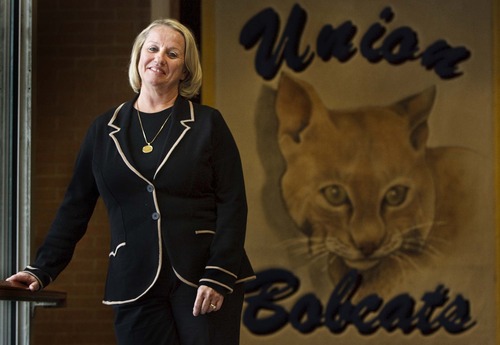
When Mary Anderson was nominated for the Utah Association of Secondary School Principals middle-school principal of the year, she received a packet of papers to fill out. Her first thought was to ignore the application.
"I really was not going to fill it out," she said. "As a matter of fact, I threw it away."
Her colleagues were shocked, but Anderson, principal of Union Middle School since 2005, said she just didn't feel comfortable taking all the credit.
"What we accomplish at Union we accomplish as an entire faculty," she said. "It's everybody coming together to do this."
Eventually, Anderson's colleagues encouraged her to accept the nomination. She went for a second-round interview and saw plenty of familiar faces of people whose work she admires.
"I went to my husband afterward and said I did a pretty good job, but I do not think I got it," Anderson said. "I saw 15 colleagues there — high-quality folks — who do a great job at their own schools."
To her amazement, the UASSP named Anderson the 2013 Utah middle-school principal of the year in early January. Although she was honored to receive the prestigious award, she said she hopes the recognition isn't for her alone.
"I hope this honor is for Union Middle School," Anderson said. "I believe this honor is for everybody, for the hard work and the changes to student learning."
Anderson graduated from the University of Utah in 1978, the same year Alta High School opened. She started as a gymnastics coach and also taught math for 18 years at Alta High before getting into administration, but her roots weren't planted in the education field or even in Utah.
"I was raised in northern California," Anderson said. "I used to dance ballet professionally with the Oakland Ballet Company through my high-school years."
At the time, the University of Utah was the only school that offered a ballet degree, so Anderson eagerly enrolled, thinking she could pursue her childhood passion.
She spent her freshman year dancing to a ballet degree, but eventually the music ceased as she realized that realistically ballet wouldn't cut it for her as a career. She moved toward education because of an incredible teacher she had.
"I loved the way he worked with kids," Anderson said about her high-school math teacher. "I think I loved math because he did such a great job of teaching it and inspiring me."
Anderson considered going into administration because she believed she could put her organizational and critical-thinking skills to use in solving problems and creating solutions.
"I really love the kids, and I really love the teachers," she said. "It's so rewarding to me when the kids feel great about their accomplishments."
As a principal, Anderson seeks to improve learning by focusing on specific areas of struggle and making changes in curriculum and doing small intervention classes.
"A big thing that hit me was about seven years ago at Union, in April 2009, we noticed that we had 50 percent of our whole school reading below grade level," Anderson said.
To remediate the problem, Anderson hired a reading specialist and implemented small-sized, specialized classes for students who were struggling.
The effort proved successful: In its first year, the percentage of students reading below grade level fell from 50 percent to 23 percent. The 2011-12 school year saw a change from 42 percent to 16 percent.
"The one thing we have to give kids is extra time," Anderson said. "That was the one thing in the past you couldn't control."
Anderson also implemented a study-skills class taught by school counselors and psychologists for students who need the most encouragement and supervision to get their work done.
"Basically it's just staying on top of them, and we're seeing success," Anderson said. "We have an average of at least a 1-point GPA increase."
Principal Paula Logan of Midvale Middle School said Anderson devotes a lot of time and effort to help not just students but colleagues as well.
"Mary has earned the respect and trust in others, and she's always wanting to help," Logan said. "We have eight middle schools in the district, and she's seen as a principal leader."
Tamra Baker, Canyons District school performance director, has known Anderson for 10 years.
"Mary is that unusual blend of someone who is super organized … but has a human touch and a great sense of humor," Baker said. "You just enjoy being around her."
Baker said Anderson's work is especially notable because Union Middle School has a lot of students who come from disadvantaged or challenging backgrounds.
"Mary has a clear vision," Baker said. "She's done an amazing job building interventions for struggling students."
In the fall, Anderson will attend a workshop in Washington, D.C., and compete for national middle-school principal of the year, sponsored by MetLife and the National Association of Secondary School Principals, but she's not thinking about that.
"My thoughts are really not there," Anderson said. "My thoughts are just plucking along with my school, my kids and my teachers."
The true celebration, she said, is not her receiving an award.
"Every year we get more and more kids reading at grade level, and that's a huge celebration" Anderson said. "Let's just keep doing what we're doing."
Twitter: @sltribMid —
Mary Anderson
Selected by the Utah Association of Secondary School Principals as 2013 middle-school principal of the year.
Graduated from the University of Utah with a bachelor's degree and Brigham Young University with a master's.
Began teaching at Alta High School, where she coached gymnastics and taught math, in 1978.
Assistant principal at Hillcrest High School and Riverton High School.
Became Union Middle School principal in 2005.