



This is an archived article that was published on sltrib.com in 2012, and information in the article may be outdated. It is provided only for personal research purposes and may not be reprinted.
The more severe combat a warrior experiences, the more likely he or she is to later attempt suicide, new research at the University of Utah's National Center for Veterans Studies shows.
It might seem like common sense, says David Rudd, the center's scientific director and the dean of social and behavioral sciences, but it had never before been empirically validated, he says.
"This has enormous implications," says Rudd, who will discuss his research with the Congressional Veterans Caucus in Washington on Tuesday and at the American Psychological Association conference in August.
It shows there are ramifications when a nation sends a small, all-volunteer military into combat over and over and over again, he says.
"The severity of your psychiatric injury, the severity of your symptoms is clearly, undeniably tied to the severity of your combat exposure."
Moreover, it puts to rest the notion that warriors become more resilient, more comfortable the longer they are in combat. That's a bromide sometimes used by those who dismiss combat as a cause because, after all, roughly half of suicides occur among military members who never leave the United States.
"It makes it hard to argue the case anymore that, 'Hey, people who haven't deployed are trying to kill themselves," says Rudd. "Yes, they are, but … it's a separate issue. What this paper helps articulate is there are two different populations of people."
For those in his study who saw heavy combat, the findings are stark: 93 percent qualified for a diagnosis of post traumatic stress disorder and nearly 70 percent had attempted suicide.
Rudd surveyed 244 veterans through the Student Veterans of America for his study, which he expects to publish soon.
Col. Carl Castro, who oversees the Department of Defense's (DoD) research into suicide prevention and treatment, says Rudd's findings contribute to a growing body of research into the "tremendous psychological and physical burden" that combat places on service members.
Says Rudd, who served as an Army psychologist during the Persian Gulf War: "I don't think there's anything more tragic than to have someone serve multiple tours in combat and survive and then kill themselves."
—
War's 'most significant consequence' • Suicide is a key focus of the National Center for Veterans Studies, which Rudd co-founded at the U. in 2010.
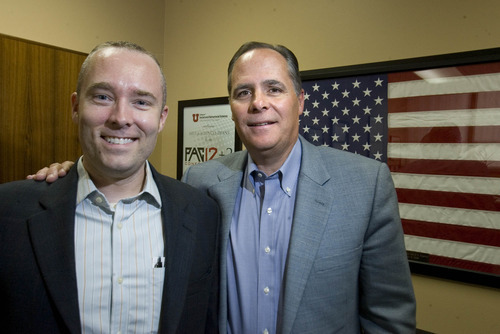
Rudd and the center's new associate director, psychologist Craig Bryan, oversee projects that are teasing out causes and determining the best treatments. The research is funded by the Department of Defense, which in recent years has poured millions of dollars into the confounding issue.
It used to be that serving in the military made one less likely to commit suicide.
Several years of war in the Middle East, when units were deploying two, three, four times, changed that.
Between 1998 and 2011, a June report showed, 2,990 service men and women died by suicide. The number per year nearly doubled between 2005 and 2009, when it peaked at about 290.
The statistics were published in the Medical Surveillance Monthly Report, a publication of the Armed Forces Health Surveillance Center.
When the number of active-duty armed service members taking their own lives dropped slightly in 2010 and again in 2011, the Pentagon took it as a sign its prevention efforts were paying off.
This year, however, suicides are on the rise again.
The Pentagon announced in June that 154 active-duty soldiers, sailors, airmen and Marines took their own lives in the first 155 days of the year, outnumbering those killed in combat in Afghanistan.
Rudd is convinced that the way the nation wages war and the nature of these wars — guerilla warfare where warriors often can't tell the difference between combatants and civilians — is to blame.
"One of the primary shifts from World War II to Vietnam to the current wars is that psychological injury is undeniably the most significant consequence at war," Rudd says. "[It] impacts far more veterans than any other kind of injury today."
In addition, there's a perceived conflict between military values — loyalty, service, sacrifice and obligation — and asking for help with mental health issues.
"People really view it as a personal failure or weakness. The [military] culture hasn't really accepted the issue in a meaningful way."
Bryan notes that suicide research has always been poorly funded, particularly given that suicide is one of the top 10 causes of death in the United States and the second leading cause for young people.
The DoD and VA-funded research under way in the past decade, however, will advance the entire mental health profession, he says.
"We're now getting to the point where we can show all the money spent is actually making a difference in soldiers' lives," says Bryan, who served as an Air Force psychologist from 2005 to 2009, the last year in Iraq.
"What we learn here in these next few years as these studies wrap up is going to actually shape the way mental health care [civilian and military] is delivered."
—
Probing soldiers' pain • Bryan created a splash earlier this summer when he delivered a paper at a DoD conference, sharing research that affirms common wisdom: Soldiers try to kill themselves to end psychological pain.
He used data from interviews with 72 soldiers who are part of a larger treatment project Rudd has had under way at Fort Carson, Colo., for nearly three years. It is nearing an end and initial results are promising.
To a person, the 72 soldiers said they tried to commit suicide or were suicidal because they wanted "to stop bad feelings."
"This provides… scientific backing that will help commanders and other service members understand this is not someone trying to get out of something," he says. The paper has been accepted for publication in the Journal of Affective Disorders.
While 10 percent of the soldiers said their suicide attempts were partially motivated by a desire to avoid an assignment or other issues, they also reported that they just wanted to end the suffering, Bryan says.
"His findings show conclusively that we must focus on addressing the suicide and distress causing it," says Castro.
Bryan's next research project will try to assess which treatment works best as a brief, intense intervention when a suicidal service member appears in an emergency room.
The field, he says, is gratifying, particularly when one sees success in treatment.
"You see people move from sheer agony. There is nothing more exhilarating than to help someone move from this dark place, to 'Things are going to be OK.' "
More on the National Center for Veterans Studies
The center at the University of Utah has several research projects and initiatives underway. Read about them here.