




This is an archived article that was published on sltrib.com in 2012, and information in the article may be outdated. It is provided only for personal research purposes and may not be reprinted.
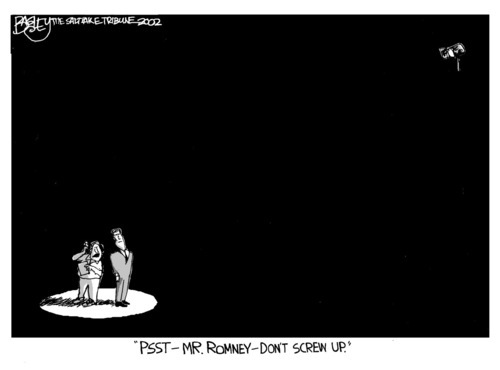
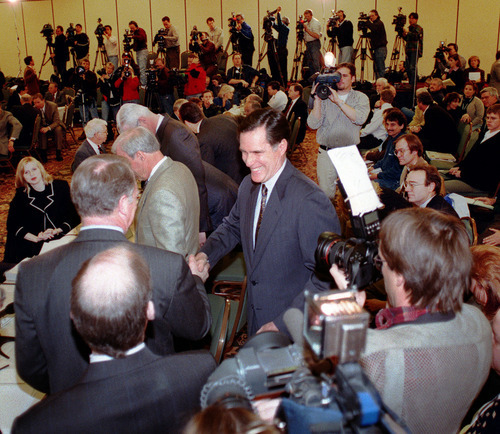
Those were dark, dark days in Utah's Olympic odyssey, back in February 1999, when Mitt Romney burst onto the scene.
News accounts still appeared daily, as they had for two months, about Salt Lake City's bid committee lavishing money and gifts on voters in an Olympic host-city selection process rife with corruption.
The International Olympic Committee, U.S. Olympic Committee and Salt Lake Organizing Committee all were investigating evidence documented in detailed bid-committee records, but most ominous of all, so was the Department of Justice.
Possible criminal charges for bribery? In the headquarters city of The Church of Jesus Christ of Latter-day Saints? How ironic, how embarrassing.
What SLOC needed, said then-chairman Robert Garff, was a "white knight" to get the shell-shocked operation back on track and to restore Utah's reputation.
Enter Romney.
He boasted a famous pedigree: the son of a Michigan governor who had run for president. He was a successful businessman. And even though he had lost, his spirited run at Ted Kennedy's untouchable U.S. Senate seat in Massachusetts had pegged him as a rising Republican star.
While not a Utahn, Romney was a Mormon. He had insight into the local culture. He was more likely to be embraced quickly by the state's largely LDS government and civic leaders. And he was eager to do his share to bring honor, not ridicule, to something important to the faith that meant so much in his life.
Romney also had bought into the idea that the Olympics were greater than just a sporting event. They were, he wrote in his 2004 book, Turnaround — Crisis, Leadership, and the Olympic Games, "a showcase of some of the great qualities of the human spirit … revealing the Olympic athlete's unrelenting drive to push the limits of human capacity."
When the Games wrapped up to much acclaim in 2002, Romney departed immediately to launch his successful campaign to become governor of Massachusetts. He left behind a world inspired by the Salt Lake City Olympics, especially coming just five months after the horrors of the Sept. 11 terrorist attacks.
How much credit Romney personally deserves for Salt Lake City's stellar showing varies. So do opinions about how much he did strictly to benefit the Olympics and how much he did to advance his own political aspirations.
Romney could not be reached for comment for this story because of the rigors of his quest to become the Republican presidential nominee. But in his book, he said "despite suspicions to the contrary, I had no plans to parlay the experience into political advantage.
"Who knew where it could lead? I gave very little thought at all to what I would do afterwards," he added. "Many people can't believe that. They think that I had calculated the political benefits. But, honestly, I had no idea. I saw no political connection at all. … I wanted to serve the community, not run for office."
Book reviewer Jesse Gordon, a Democratic activist in Massachusetts, didn't believe that "for one second."
"Everyone in Massachusetts politics, including myself, always assumed Romney would run for office again, and fully expected him to segue from the Olympics to a gubernatorial run. If Romney was surprised by that turn of events, he was the only one!"
What about Romney "saving" Utah's Olympics?
In his book, he takes great pains to attribute the success of the Games to the team he and his predecessors at SLOC put together — from supportive federal officials in Washington, D.C., to a volunteer corps of 26,000 in the Beehive State. He acknowledged his responsibility was big — as the face of the Games, the herald of its values and the guarantor of a pledge to deliver the event on budget — but said that his high-exposure role was necessary to distinguish the new-and-improved SLOC from the old corrupt one.
Such high-minded pronouncements do not ring entirely true to two of Romney's more vocal local critics, who argue he exaggerated SLOC's problems to make himself look better when Salt Lake City's Olympics rebounded.
Ken Bullock, who represented the Utah League of Cities and Towns on SLOC's board, said "Romney was a great face for the Games. He deserves credit, just not all the credit he's claiming.
"We did not have a crisis in hosting or managing the Olympics. It was a crisis of image, a crisis related to the IOC. That's not to say he didn't do a good job and play a vital role," Bullock said. "But so did [bid leader] Tom Welch. Tom was a great visionary. He displayed the tenacity, convictions and passion to pursue it. He's forgotten. And Frank Joklik? With his engineering background, he put the scaffolding together. Mitt did a nice job putting meat on the bones."
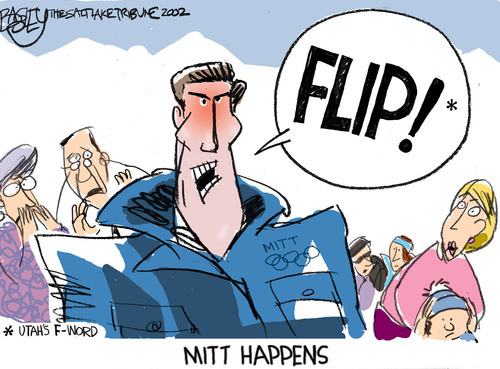
Steve Pace, a studious skeptic whose scandal-inspired "Slalom and Gomorrah" T-shirt quickly caught Romney's eye, conceded SLOC's new leader "did an incredible job and built bridges."
"But Mitt's efforts here," Pace said, "were more about Mitt than the greater glory of the Olympics or helping out Utah."
For every critic, Romney has many more devotees.
"The people who work with Mitt remain loyal to him. I'm one of the people who's loyal," said SLOC trustee Jim Jardine, who met Romney in 1971 while both were at Harvard.
"Mitt was, from the first day I met him, among the most charismatic, talented people I've met," Jardine said, adding that Romney's skills fit SLOC's needs. "We had to have somebody to embody what we were about, to go to different places and persuade people to support us. He put himself on the line in the commitment that the Games would be done right."
Fraser Bullock, no relation to Ken, was Romney's first key hire after taking the helm. A former Romney colleague at Bain Capital, Bullock oversaw the voluminous details of staging an Olympics, freeing Romney to pursue money from corporate sponsors, rich donors, the federal government and the IOC.
"Our Games were an opportunity for Mitt to demonstrate his capability and also to grow his capability," said Bullock, now managing director of the Salt Lake City-based private equity firm Sorenson Capital. "He came into a very difficult situation, assembled very capable people and created a common vision — along with concrete steps to achieve that vision — that resulted in a remarkable outcome."
Success did not come easy. Besides the scandal fallout, the USOC-led effort to secure corporate sponsorships had bogged down. SLOC was about $400 million short of what it needed to run even a pared-down Games.
"Mitt went out on the road, all around the country, visiting all of these corporations and produced record sponsorship sales," Bullock said. "Mitt got in gear, saw what needed to be done and got it done."
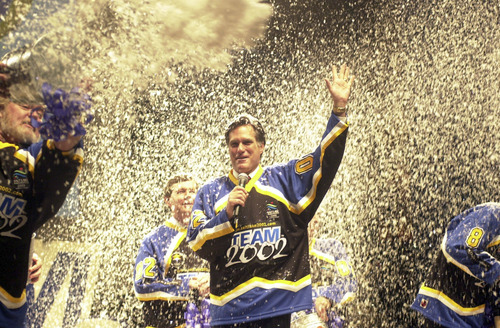
Romney's other main responsibility was to rebuild morale — at SLOC, inside the community, across the country and around the world. That effort, he wrote, often put him on center stage, personifying the post-scandal Games. It required a dizzying schedule of face-to-face meetings, pats on the back, a rule that meetings start with a joke and, now and then, a willingness to be goofy, like the time he showered photographers with cereal at a sponsor announcement.
"He solved the crisis of confidence," said Shelley Thomas, SLOC's vice president of communications under Joklik, through the scandal and partway through Romney's reign. "The scandal had been tremendously punishing on the staff. It was a relief to feel that new leadership was in place, that community support was shifting back and that people could go ahead and do their jobs."
Never were his assurances needed more than after Sept. 11.
Cancel the Games?
No way.
The Games were crucial, Romney said, "as a visible demonstration of solidarity and the enduring principles of civilization."
He told SLOC staffers in an email: "I am honored that I can join you in work that means so much to our nation and to the world. In the annals of Olympism and the history of Utah, this may stand as one of the defining hours. I am confident that we will perform with honor."
They responded. So did the athletes; none stayed home for fear of more terrorism. Volunteers went to their assignments from start to finish; absenteeism was incredibly low. Spectators showed up en masse; ticket sales topped 1.52 million, 95 percent of what was available, a higher share than in any previous Olympics, summer or winter.
Jacques Rogge, then and now the IOC president, was impressed.
"We couldn't speak more highly of [Romney] for his role in turning the Salt Lake Games around," he told The Salt Lake Tribune in an email. He, Fraser Bullock and their team did a truly remarkable job in delivering an incredible event for the athletes, spectators and city alike and leaving a strong legacy for the region. He was a delight to work with."
For Garff, Romney's success in leaving Utah with a $100 million profit and a priceless sense of collective accomplishment justified his description as a dashing knight who would lead the community out of crisis and then continue on a noble quest.
"Mitt has a persona larger than life," Garff said. "To me, it was obvious he had a plan, an agenda, and the Olympics fell right into it. He never told me he'd run for governor of Massachusetts. But I knew he was an ambitious man who had his mother's good looks, his father's charisma and his own intellect. I knew he was a man going somewhere."
Right now, Romney's hoping it's to the White House.
mikeg@sltrib.comTwitter: @sltribmikeg