



This is an archived article that was published on sltrib.com in 2013, and information in the article may be outdated. It is provided only for personal research purposes and may not be reprinted.
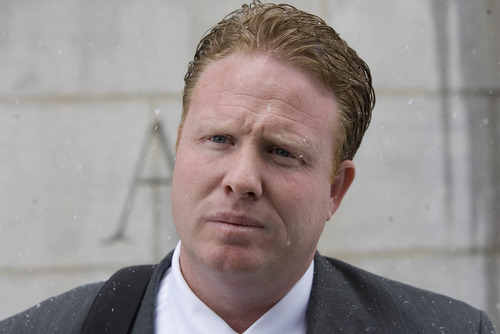
Now the federal government has joined a new high-stakes battle with St. George businessman Jeremy Johnson.
With a revised indictment on 86 charges — as opposed to the previous single charge — federal prosecutors have set the stage for a fresh round of legal skirmishes with the online sales entrepreneur.
This time, though, Johnson has company — four of the men who helped him run his company called I Works, which was highly profitable until it was sunk by mounting problems with customers demanding their money back for charges some said were unauthorized.
The new indictment made public Wednesday essentially elaborates on the charges Johnson was set to plead guilty to in December when he sank a plea deal that would have netted him about 11 years in prison.
Now Johnson and the four I Works employees — Loyd Johnston, Bryce Payne, Ryan Riddle and Scott Leavitt — face up to 30 years in prison if convicted on charges of conspiracy, bank fraud and money laundering.
The indictment revolves around whether the five defrauded Wells Fargo Bank when things began to go sour at I Works, which had taken in $275 million from about 2000 to 2010, with Johnson's take about $50 million, according to legal documents.
I Works sold various products over the Internet, the most popular being access to websites about how to obtain government grants for personal expenses, make money at home using Google, and lose weight and stay healthy.
According to the new indictment, beginning sometime around 2006, an increasing number of customers started reversing credit card charges from I Works and affiliates. Consumers were unaware that when they ordered a CD or another product for a shipping and handling fee of about $1.99 or so, they also had agreed to be billed monthly for charges of up to $60 for a complementary service or product.
Some also were "upsold" additional services and products without their knowledge, the Federal Trade Commission alleged in a 2010 lawsuit.
Johnson acknowledges disclosures of what's known as upsells on early I Works websites could have been better, but he disputes that the consumers were largely unaware of the charges. He points to the 3 million or so people who called to cancel before they were actually billed, citing that as proof that disclosures were adequate.
Still, federal prosecutors say that in 2009, banks began cutting off I Works credit- and debit-card processing accounts after the company's charge-backs began exceeding 1 percent of all its total charges, the maximum set by Visa and Mastercard.
That allegedly drove Johnson and the other four to start creating shell companies that disguised their relationship with Johnson and I Works. Otherwise they would not have been able to open new accounts and keep charging customers, prosecutors say.
According to the indictment, Johnson sent a text to Johnston on May 11, 2009, instructing him to set up new accounts "without my name on them."
It also cites other messages to Johnson about creating various companies using names other than Johnson's, and he replies: "I am OK with this but I still want back up merchant accounts [even if we just use them a tiny bit to keep them open] and I want many different corps so all the processing is broken out in many places and I want the ability to put shit processing in one of those corps not tied to us at all knowing full well it will blow up in a few months."
Johnson or his employees are accused of preparing applications for merchant accounts that had straw owners, false business histories, used drop boxes for mailing addresses and referred to fake websites set up only for banks or underwriters to verify they were in compliance with regulations but through which no actual sales were ever conducted, the indictment says.
Johnson and his co-defendants' story is at odds with that portrayal.
Johnson has said that I Works' charge-back problem largely came about because it was the victim of fraud by other companies with which it had contracted. I Works was paying $40 or so to outside companies when those companies sold I Works products. Some used stolen credit cards to make a sale, received their commission and then did a charge-back, he said in interviews before a judge warned him not to talk to the media.
Some companies put up blogs with fake testimonials and drove sales that way, while making it difficult for I Works to trace the source of those sales, he said. Ultimately the fraud helped sink the company, Johnson claims.
By 2009, it was apparent the I Works business model wasn't working. The company gradually ceased operations so that by end of the 2010, when the FTC sued, it was making no sales and barely functioning, Johnson said.
Now he and the other defendants are protesting loudly, saying they are the victims of a face-saving vendetta on the part of the U.S. Attorney's Office that wouldn't back down when it found it had no case. They based their protest on a previous indictment that named only Johnson on one count of mail fraud.
The U.S. Attorney's Office declined to comment.
Johnson has said the new companies created to continue processing cards were formed legally at the suggestion of card processors in an effort to try to isolate and then get rid of outside vendors who were causing the high charge-back rates or who were defrauding I Works.
"That was the idea," he said. "It never worked."
Riddle, once I Works general manager, also said there was no intent to defraud in setting up the new companies and getting new accounts.
"The laws for setting up companies and opening processing accounts were followed by I Works," Riddle said in an email. "It was never I Works' intention for anyone to not know Jeremy or I Works was involved in the processing."
While the indictment says false information was submitted to a California card processor called CardFlex and used to open Wells Fargo accounts, Johnson claims he fully disclosed I Works' charge-back problems to CardFlex President and Chief Executive Andrew Phillips.
"Before I did processing with them I sat down with Andy and told him everything that was going on and the issues we were having," Johnson said in a Dec. 5, 2012, interview.
He also claimed two CardFlex agents who met with Assistant U.S. Attorney Brent Ward and IRS Special Agent Jaime Hipwell were told of that meeting and that CardFlex was fully aware of what I Works was doing.
Johnson also said he was never aware the processing was being done through Wells Fargo.
"We never filled out a Wells Fargo application," he said. "It was a CardFlex application and CardFlex could pick any bank they wanted."
CardFlex did not return an email and phone call seeking comment.
Riddle also said CardFlex and agents who set up accounts with processing companies directed I Works to form the new companies in order to obtain new accounts to continue processing but also to isolate affiliates and others who were defrauding the St. George companies. Company histories and profit-and-loss statements as well as number of employees put on account applications were from previous companies being absorbed into new ones as I Works tried to combat fraud, he said, describing a kind of wink-wink relationship between I Works, processors, their agents and banks.
"For brand-new companies with no 'history' it is rare to get a merchant account where you can process more than $50,000 per month," Riddle said in the email. "Because of the sheer volume it was obvious to all that everyone involved knew the processing was owned previously by I Works, and new daily sales would be under new companies with Jeremy as a guarantor."
His account of the relationship with agents of processors is in line with that of a former employee, though her version of the intent of the operation is at odds.
Tracey Kramm, in an affidavit that is part of the FTC lawsuit, said that it wasn't until about April 2009 after banks began to shut down card-processing accounts that I Works started to make changes to what she viewed as problematic marketing websites.
At the instruction of her bosses, Kramm said she began creating the new companies that did not appear to be associated with Johnson or I Works. Part of that process also involved creating dummy websites associated with the new companies that were reviewed by underwriters and processors for compliance with marketing standards.
"Mr. Johnston and the agents for CardFlex stated that the dummy [websites] could not include I Works upsells because CardFlex would not process sales for sites that included an upsell," Kramm said in the statement. "However, it was made clear to me that I Works' existing sales sites would not be changed and would continue to include upsells."
Kramm said she was fired in August 2009 supposedly for saying negative things about the company. She later filed a complaint with the FTC, according to her affidavit.
Kramm's statement says there was collusion between agents of some processors and I Works to hide the connection between the new companies and Johnson. Attached to her statement was an email in which an agent for a processor said he was moving ahead with opening an account but would only include Johnson's personal financial guarantee after approval in order to avoid having to disclose that I Works' accounts had previously been shut down.
That same agent was receiving $4,000 a month fromI Works as a consultant, Kramm said.
Arraignment for the five defendants is set for April 10.
tharvey@sltrib.comTwitter: @TomHarveySltrib —
Charges and sentences
Below are the charges and possible prison sentences facing Jeremy Johnson, Loyd Johnston, Bryce Payne, Ryan Riddle and Scott Leavitt. The sentences upon conviction likely would take into account federal sentencing guidelines.
Conspiracy • Five years
False statements to a bank • 30 years
Wire fraud • 20 years
Bank fraud • 30 years
Fraudulent banking activities • 30 years
Money laundering • 10 years. The Swallow case
Indicted St. George businessman Jeremy Johnson has alleged that Utah's new attorney general, John Swallow, helped broker payoffs to enlist the aid of Senate Majority Leader Harry Reid in derailing a Federal Trade Commission investigation of Johnson's I Works business.
Swallow and Reid have vehemently denied the allegations. The U.S. Attorney's Office has said it is investigating.