





This is an archived article that was published on sltrib.com in 2013, and information in the article may be outdated. It is provided only for personal research purposes and may not be reprinted.
Jana Francis understands what Yahoo! CEO Marissa Mayer is going through.
Francis, founder and president of a Salt Lake City-based web network, sees why Mayer made the highly unpopular decision of requiring all Yahoo! employees to come into the office to work instead of telecommuting from home.
"When trying to grow a business, doing that remotely is very difficult because of two things: communication and collaboration," said Francis, who founded a network of daily-deals websites including Steals.com and BabySteals.com.
"When times start to get tough and they need to hone and tighten their business,'' said Francis, ``she [Mayer] really has no choice."
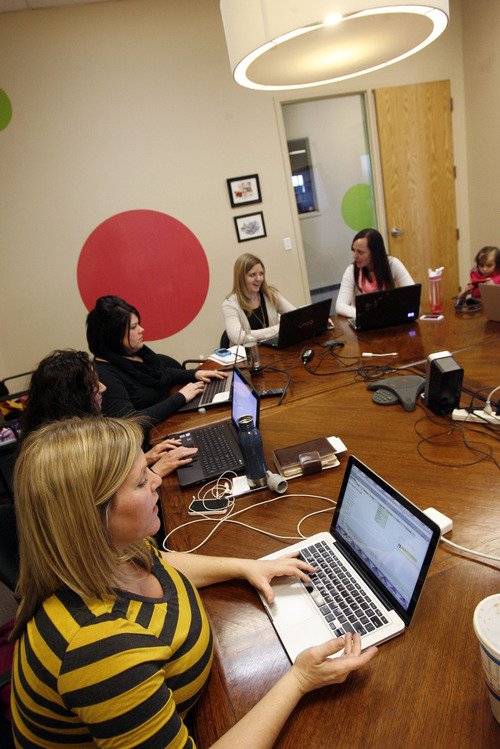
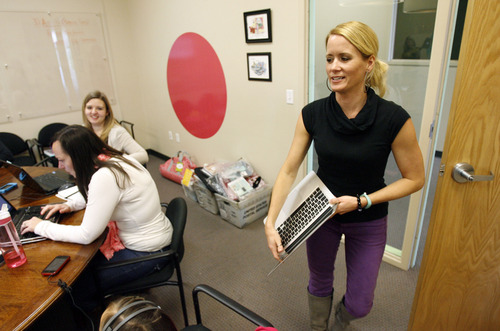
Coincidentally, Francis also must decide whether to make her employees come into the office on California Avenue more than before. Currently, about 40 of her 74 employees work at least part of the week from home via computer, known as telecommuting. She said Wednesday she'll probably ask workers to be in the office at least three days a week.
"Our goal," she said, "is to have more collaboration and communication in person and to create those relationships and teamwork."
Renewed debate on telecommunity broke out this week with revelations of the new Yahoo! policy, brought to light with a memo leaked to the blog AllThingsD.com. The internal company memo, written by Yahoo's human resources head, Jackie Reses, orders hundreds of Yahoo! employees now working at home to show up in the office every day, starting in June.
"Speed and quality are often sacrificed when we work from home," Reses told Yahoo! employees. "We need to be one Yahoo!, and that starts with physically being together. For the rest of us who occasionally have to stay home for the cable guy, please use your best judgment in the spirit of collaboration."
With that, Mayer won praise for her courage in instituting a hard-nosed policy in the face of Yahoo's dragging performance as well as harsh criticism for what some see as an archaic rule in the Internet age.
One thing most agree on, however: Such mandates can be a morale-killer.
Washington Post columnist Ruth Marcus called the move "draconian" and implied that Mayer was being hypocritical because the Yahoo! CEO — a new mom herself — was able to afford her own personal daycare room adjacent to her office, a luxury regular employees don't have.
Salon.com noted that Yahoo's policy "is setting back the progress and flexibility that some employees have been able to enjoy," with a heavy impact that "falls disproportionately on women."
Mommy bloggers also criticized Mayer, including ScaryMommy.com and BabyCenter, which said the Yahoo! mandate is "completely out of touch with the modern workplace." Even billionaire Richard Branson wrote that Mayer's policy was a "backwards step in an age when remote working is easier and more effective than ever."
"To successfully work with other people, you have to trust each other," Branson wrote in his blog. "A big part of this is trusting people to get their work done wherever they are, without supervision."
With advances in networking and mobile devices, it has become easier to work away from the office, so more people want to do it.
In 2010, 9.5 percent of working Americans worked from home at least once a week, according to the latest U.S. Census Bureau data. And according to a new study by job-placement company, Robert Half Technology, three quarters of IT professionals surveyed nationally said it was important that their job had an option to work from home if needed.
"The result of this survey rings very true for the Utah market," said Justin Rohatinsky, branch manager for consulting services for Robert Half Technology in Salt Lake City. "With snow, a lot of them believe they can be more productive on those days instead of driving into work. They can just log in and work instead."
But Francis said that doesn't apply to every company. Rapidly growing firms with changing demands often need employees present for quick decisions and collaboration, she said.
"It was OK [to work from home remotely] when you have five or six or seven that can work on the same page,'' Francis said. ``But as our company grew, we found it got worse, not better."
Whether office face time breeds innovation and improves communication is an open question, with some studies suggesting otherwise.
Research at a Chinese call center by Stanford University showed a sample of employees who worked at home had a 13-percent higher productivity level over those in an office, and such workers took fewer sick days and fewer breaks while on the job.
Home workers also reported higher work satisfaction, better work attitudes and lower attrition rates, according to the Stanford study, released last week.
In a 2010 study at Brigham Young University's School of Family Life, telecommuters were better able to balance family and work life than those who worked at an office. The study, published in the Journal of Family Psychology, also found that telecommuting benefits a company more in a troubled economy.
"A down economy may actually give impetus to flexibility because most options save money or are cost-neutral," wrote the study's lead author, BYU professor E. Jeffrey Hill. "Flexible work options are associated with higher job satisfaction, boosting morale when it may be suffering in a down economy."
Google+: +Vincent Horiuchi