




This is an archived article that was published on sltrib.com in 2013, and information in the article may be outdated. It is provided only for personal research purposes and may not be reprinted.
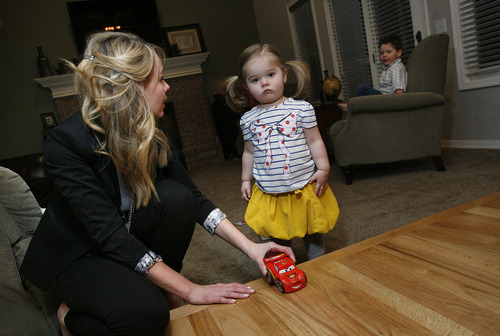
Nearly 38 weeks into her pregnancy, Rebecca Hunter delivered Chloe and Sean, a set of healthy fraternal twins.
And for the next 12 weeks, she spent time feeding, diapering, nurturing and snuggling the babies and their older brother, then age 2, at their Herriman home during a maternity leave.
On Wednesday morning, Hunter went back to work at MountainStar Healthcare.
"I left the house with one of the babies crying," Hunter, 36, said. "Fortunately, my baby sitter texted me a picture of the baby smiling shortly after I got to the office. I'm sure I'll be hanging onto those pictures every day."
While she deals with the tough transition of returning to the office, Hunter said she's grateful she had a job to go back to, something she credits to the Family and Medical Leave Act, or FMLA.
"I think it would have been very difficult emotionally and physically not to have had those 12 weeks," Hunter said. "I definitely appreciate the bonding time and I think it's really needed."
Twenty years ago this week, President Bill Clinton signed FMLA into law. Since then, millions of workers such as Hunter have taken a temporary unpaid leave to care for a newborn, heal from an injury or care for an aging parent without the threat of losing a job.
What many workers take for granted today was revolutionary at the time.
"I remember basically being very new in human resources and thinking, 'I get this,'" said Deborah Stone, of Evolutionary HR, a human resources consulting company.
At its core, FMLA allows workers to take an extended leave without pay but with benefits — up to 12 weeks — for a medical reason, including the birth or adoption of a child, the care of a family member or a personal health condition. The bill only applies to companies with 50 or more employees. To qualify, employees need to have worked at the business for at least a year.
"What FMLA does best is it gives people who are employed security, so they can both keep their health insurance intact and have a job to come back to," Stone said.
For Anne Robertson, that meant peace of mind during two FMLA maternity leaves, one for her son, Ryker, who's now 3, and another for daughter Katie a year-and-a-half ago. Robertson, 31, who lives in Cottonwood Heights and works at Intermountain Health Care, admits that in some ways, she took the job and insurance guarantees for granted.
"FMLA wasn't really on my radar," Robertson said. "It made it so I enjoyed that three months with my son. It made it so I didn't even think about work. That definitely was very nice to have."
That security has benefits for both employees and employers, according to a recent Department of Labor survey. The study shows that 91 percent of employers report that complying with the law has had little or no effect on employee absenteeism, turnover or morale.
And with 90 percent of workers who use FMLA returning to work after a leave, the report notes that there's little risk to businesses.
While most say FMLA is the right thing to do for workers and their families, the law does present challenges. Jeanine Wilson, director of the Utah Human Resources State Council, or SHRM, says the law has been difficult to execute.
"I don't think anybody realized it would become as onerous as it has been to administer," Wilson said. "From an HR viewpoint, it was one of the most onerous pieces of legislation ever passed."
Stone agrees.
"Employees love it; employers struggle with it," she said.
Stone said one complicating factor is that those who qualify for FMLA may also be covered under the Americans with Disabilities Act (ADA) and if it's an injury that occurred on the job, the person may also have a workers' compensation claim. Each has its own set of requirements and paperwork, and Stone said human resource professionals often affectionately refer to the overlapping web of laws as the "Bermuda Triangle."
Still, Wilson contends the end product is worth the headache.
"As an employee, I think it was overdue," Wilson said. "We needed a way to protect workers and this [job protection] provides one less piece of stress during a health crisis. Prior to FMLA, we saw people lose their jobs because of a sick child, and that's not right."
Wilson predicts that family-friendly business practices and legislation, such as lowering the 50-employee requirement of FMLA and promoting flexible work hours, will continue.
"The FMLA will continue to be tweaked, depending on the feeling in Washington," she said.
According to HR.BLR.com, an online resource for human resource managers, recent changes include expanding leave for employees who are caring for a military spouse, parent, son or daughter, as well as revised eligibility requirements for airline flight crew employees, such as pilots and flight attendants. Local jurisdictions are also getting in on the act, with states such as Washington implementing a paid family leave law in 2015 and cities such as Philadelphia requiring companies that do business with the city to provide paid leave to their full-time employees.
All of this is good for workers such as new mom Hunter. She contrasts her experience with a neighbor who works for a very small company and does not qualify for FMLA.
"It's definitely been an advantage for me personally," Hunter said. "As a mother, it's been great."
The Federal Medical Leave Act
Under FMLA, qualified employees are guaranteed time off from work for medical reasons. To quality:
• An employee must have worked at the company for at least a year, working at least 1,250 hours during that time.
• An employee must have a serious health condition, be the caregiver of a family member with a serious health condition, be the parent of a newborn or adoptive child or be next of kin for a covered active duty military service member.
• Only businesses with 50 or more employees must comply with FMLA.