



This is an archived article that was published on sltrib.com in 2013, and information in the article may be outdated. It is provided only for personal research purposes and may not be reprinted.
While the hospitality industry deals with the ever-shifting landscape of liquor laws in Utah, local brewers are making big moves in the state and outside its borders to expand their reach and grow their bottom lines.
Faced with a chronic shortage of liquor licences and a change of leadership at the state's liquor-control agency that has created a host of compliance challenges, restaurant and club owners have been scrambling to navigate the choppy waters of doing business in one of five states where the government runs the entire alcohol distribution system.
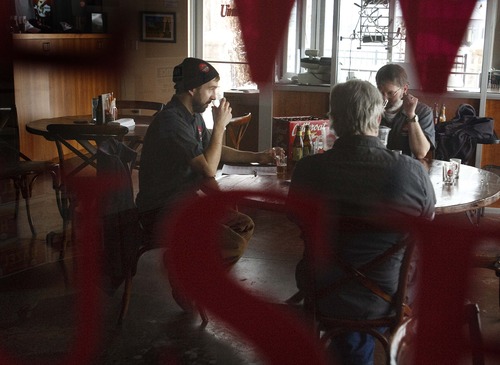
Brewers, of course, have not been immune to state laws, which now make it illegal for one customer to be served multiple drinks, effectively outlawing trays of beer samplers. In addition, breweries holding restaurant licenses are forbidden from opening bottles of beer in view of their customers. And one is even worried that its food service operation may come under scrutiny because through it the brewer can sell packaged full-strength goods on Sunday.
But those concerns aside, breweries are pressing forward with plans to build up their businesses to meet the demands of consumers in Utah and beyond. Since 1986, their numbers have grown from zero to 18.
Craft brewing has been growing nationwide since the 1990s, said Mike Riedel, author of the Utah Beer Blog at http://www.utahbeer.blogspot.com. But given the myriad liquor restrictions in Utah, "it took awhile for [the phenomenon] to catch on here. And although Utah has the lowest beer consumption in the country, it's proven to be a popular business to get into here."
One of the state's oldest and largest brewers, Uinta Brewing Co., is an example.
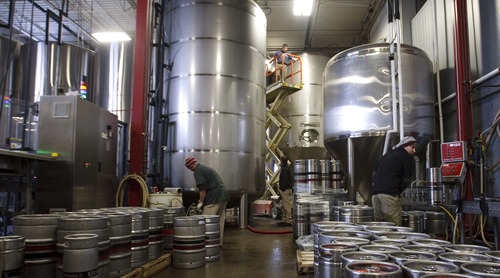
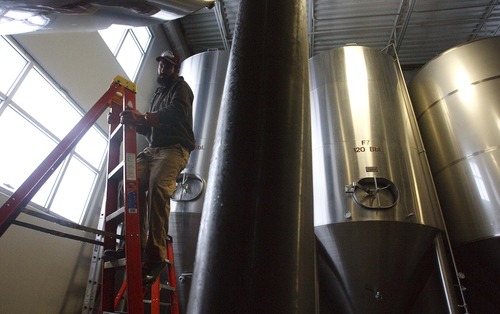
Uinta's Salt Lake City brewery is planning a $12 million expansion that will increase its capacity from 45,000 barrels per year to 130,000 in the next few years and continue its rapid pace of growth.
Founder Will Hamill said last year's output was up nearly 70 percent from 2011, on top of a 38 percent spike in 2010. And although the company ships to 24 states, including to both coasts, "Utah is our No. 1 market."
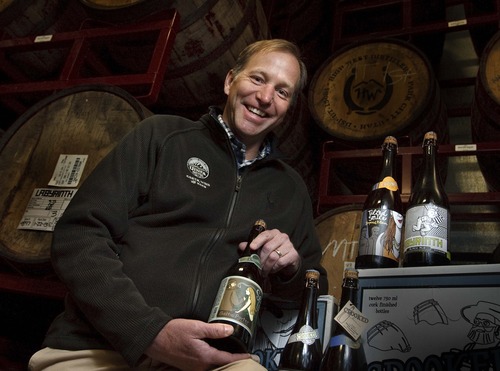
To accommodate the Utah market, about half of the Uinta brews contain an alcohol content higher than 4 percent by volume (in Utah speak that's 3.2 percent by weight), the amount required for draft beer and beer sold in grocery stores. But heavier beers also are produced, many aged in oak barrels placed in large wine-size bottles and sealed with corks. For its Crooked Line, Uinta purchased a custom machine from Italy that fills and corks the 750 ml bottles.
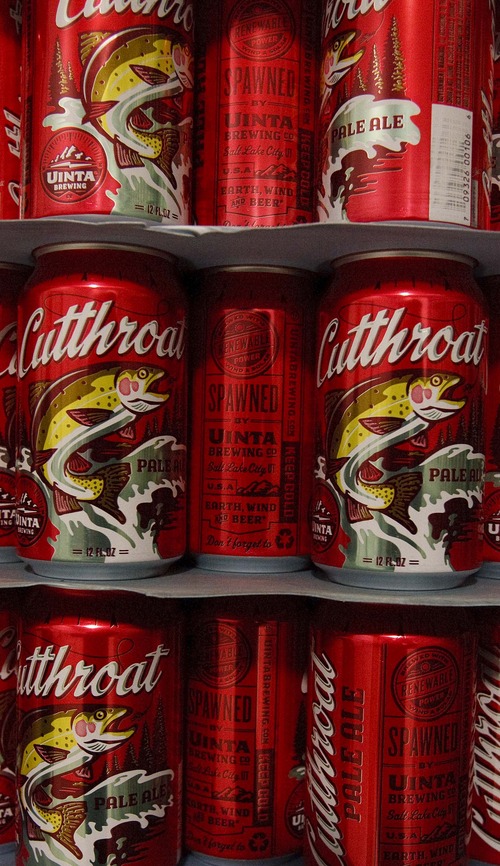
The company, named for Utah's highest mountain range, recently purchased a German canning line, and will be putting its flagship Cutthroat Pale Ale and Hop Notch IPA in those containers, starting this spring.
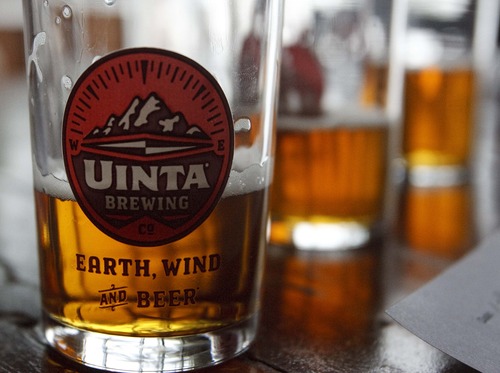
In 2001, Uinta became the first major business in Utah to generate all of its electricity from the wind, which Hamill saw as a marketing edge, saying at the time: "We want people to know that our beer is made with yeast, hops, barley water — and wind." In 2011, the company installed solar panels that today account for 20 percent of its power.
Hamill, an avid home brewer, started Uinta in 1993 "after deciding that I needed a job." Since then, revenue has steadily increased, from $785,000 in 1995 to $15 million last year, which he credits to "our passionate team and fantastic world-class beer."
Other entrepreneurs hoping to follow in his footsteps got a big break in 2008, when the board that oversees the Utah Department of Alcoholic Beverage Control decided to allow breweries to sell their beverages on-site. That meant brewers no longer had to ship bottles in warm trucks to the state's unrefrigerated Salt Lake City liquor warehouse — and then have it shipped it back to themselves before selling it to their customers.
The change allowed biologists David Cole and Peter Erickson to envision getting into the business, but cutting through Utah's regulatory jungle would take two years before they could build a facility and the get all the required approvals.
"It was a leap of faith," Cole said of the construction. "It reminded me of the movie 'Field of Dreams,' that if you build it they will come."
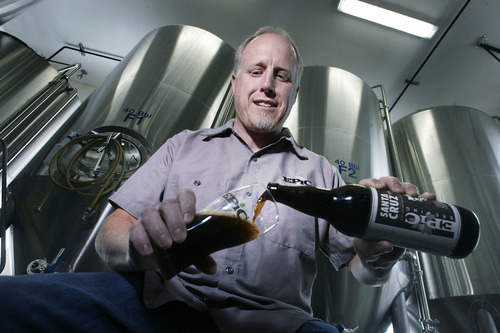
The men formed Epic Brewing Co., purchased a former Vietnamese restaurant and remodeled it into a brew house and retail store at 825 S. State in Salt Lake City. At the time, Uinta was at the forefront of producing high-alcohol beers, "which goes to show that there is a thriving market for unique craft beers in Utah," said Cole.
The brewery started with six fermentation tanks, which has grown to 18. Half of its heavy beers are consumed within Utah borders, from state liquor stores, restaurants and bars. "We also export to Brazil and Japan, and right now, our full-strength beer is on tap in Tokyo," said Cole.
The company also distributes to 12 other states, including Colorado, where Epic plans to open a brew house and taproom in April. The new 19,000-square-foot facility in Denver's River North area will focus on brewing Epic's Exponential series, with an emphasis on its popular barrel-aging program. The company anticipates using 1,000 wood barrels within the year.
Initial production in Denver is expected to be about 6,000 barrels per year, with an expansion allowing for 33,000 barrels. It's Utah brewery sold 7,400 barrels last year, nearly double its production of 4,400 barrels the year before.
Epic, known for its boutique, full-strength, ales and lagers, also is looking into opening a pub and small brewery in the Sugar House neighborhood of Salt Lake City. But draft beer in Utah cannot be more than 4 percent alcohol — which means the company would not place its brand on tap beers if it decides to go through with the endeavor.
"It's not Epic if it's not full strength," said Cole. "Utah needs to grow up on its liquor laws."
Utahns are developing a taste for full-strength beer, with the average per capita consumption increasing from 0.3 gallons in 2006 to 0.5 gallons today, according to the state's liquor agency.
Epic and Uinta are among seven breweries of varying sizes in the Salt Lake City area and 18 statewide — a surprising number given the fact that in 1986 Greg Schirf opened Utah's first brewery in many years, in Park City, introducing its inaugural Wasatch Premium Ale.
By 1994, Schirf expanded brewery operations to Salt Lake City at 1763 S. 300 West. Six years later, Wasatch merged with Squatters (Salt Lake Brewing Cooperative) for draft and bottle production. Brewery production has grown, doubling from five years ago and increasing at an average of 20 percent each year, producing 39,700 barrels last year.
In September, the Boston-based private-equity firm Fireman Capital Partners made a major investment to support the expansion of Squatters and Wasatch Beers' distribution, marketing and brew pub businesses. The amount was not disclosed.
At the time of its investment, Fireman noted that craft brewing is a $1.1 billion industry in the United States, growing from 3 percent of total beer volume in 1994 to 6 percent today. It is expected to increase to 10 percent by 2016.
Squatters and Wasatch Brewery also distributes its beer to Oregon, Nevada, Arizona, New Mexico, Texas, Louisiana, Wyoming, South Dakota, Nebraska, Minnesota and Wisconsin. Selling Utah beer to the latter state was a personal triumph for Schirf, who grew up in Milwaukee, dubbed the Beer Capital of the World.
"I like to say I am from Utah and I am on a different kind of mission," Schirf said during Wasatch Beer's 25th anniversary celebration. "Now I have gone full circle and I have my beer in Wisconsin. How cool is that?"
twitter@DawnHouseTrib —
Utah breweries
Salt Lake City:
Desert Edge Brewery • 273 Trolley Square
Epic Brewing Co. • 825 S. State St.
Red Rock Brewery • 443 N. 400 West
Red Rock Brewing Co. • 254 S. 200 West
Squatter's Pub Brewery • 147 W. Broadway
Uinta Brewing Co. • 1722 S. Fremont Drive
Utah Brewers Coop • 1763 S. 300 West
Layton:
Roosters Layton • 748 W. Hertiage Park Blvd.
Midvale:
Bohemian Brewery & Grill • 94 E. Fort Union Blvd.
Hoppers Grill & Brewing Co. • 890 E. Fort Union Blvd.
Moab:
Moab Brewery • 686 S. Main
Ogden:
Roosters Brewing Co. • 253 25th St.
Park City:
Shades of Pale • 1950 Woodbine Way No. 5
Wasatch Brew Pub & Brewery • 250 Main St.
Springdale:
Zion Canyon Brewing Co.• 2400 Zion Park Blvd.
Tooele:
Allstar Brewing Co., • 1641 N. Main St.
Vernal:
Hop N' Keg Brewery • 29 S. Vernal Ave.
Vernal Brewing Co. • 55 S. 500 East