



This is an archived article that was published on sltrib.com in 2012, and information in the article may be outdated. It is provided only for personal research purposes and may not be reprinted.
It's a toss-up. To measure the meaning of Union Pacific on its 150th birthday, you can look backward at its history or forward at the prospects for its future.
Either way, UP at its sesquicentennial is unconventional. Not many publicly traded companies have survived as long. And the ravages of time haven't diminished its prowess. UP's best-ever financial year was 2011. In a difficult economy, the company earned $3.3 billion on revenue that jumped 15 percent from 2010. Not surprisingly, its stock price has never been higher.
"It's an interesting combination of the past and the future," said Dan Snow, a professor of supply chain management at Brigham Young University's business school.
With close to 32,000 miles of track in 23 states built up over 15 decades, "I think if you were trying to start [UP] today, I don't think you could do it if you had to. I don't think there's any economic way," Snow said.
"The future? It's kind of wide open and interesting. People look at an old technology like rail and say it's done," replaced by speedier trucks and aircraft, Snow said. But "if in the future what becomes more important to us as a society, if we shift our focus away from speed and more toward efficiency or environmental impact, then trains and Union Pacific will look really cool."
The beginning • The Omaha, Neb.-based transportation company's story began on July 1, 1862, when President Abraham Lincoln signed the Pacific Railway Act, a measure "to aid in the Construction of a Railroad and Telegraph Line from the Missouri River to the Pacific Ocean."
The law "authorized and empowered [Union Pacific Railroad Co.] to lay out, locate, construct, furnish, maintain and enjoy a continuous railroad and telegraph," from the 100th Meridian to the western edge of the Nevada Territory on a 400-foot-wide right-of-way. Any land claimed by Indian tribes inside the swath would be "extinguish(ed) as rapidly as possible."
Grading work for the rail bed began in Omaha in March 1864. Four years and nine months later, on Dec. 10, 1868, construction was completed to Wahsatch, Utah Territory, at the top of Echo Canyon a few miles west of Evanston, in Wyoming Territory. Under terms of a contract signed by Brigham Young with UP, Mormon crews extended the line to Ogden in March 1869. Two months later, on May 10, construction was completed to Promontory Summit, where the line joined another line that Central Pacific Railroad had built eastward from Sacramento, Calif.
"All of a sudden, you could haul your family across the country in four or five days, when it used to take four months in a covered wagon," Gene Sessions, a Weber State University history professor, said.
The first transcontinental railroad had an immediate effect. Suddenly, Western goods could be shipped to the East, while products made in the East could be shipped as far as California. Sessions said the line also changed what people did for a living. Farmers, for instance, could grow cash crops that could be sold anywhere in the country where rail was available. No longer did they need to rely on local markets.
"It had the effect of shrinking the size of the country dramatically. Most people have no concept of the magic it created," Sessions said.
More for Utah • More than a century later, UP is not finished with Utah. Over the years, it has built 1,250 miles of track in the state. Payroll for 1,400 employees averaged $87,000 last year. When the company incorporated in 1969, it made Utah its legal home for reasons that seem lost to history. Every year in May, UP holds its annual stockholders meeting in Salt Lake City.
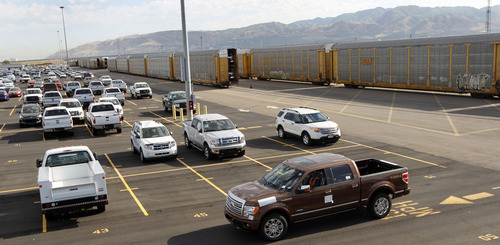
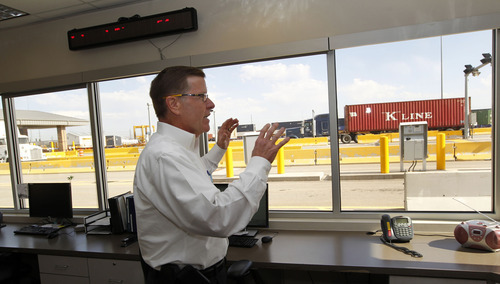
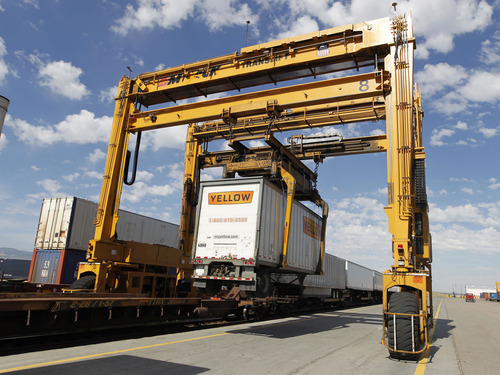
In 2006, UP opened a $90 million intermodal hub on the northwest side of Salt Lake City that in a year can lift as many as 250,000 shipping containers onto double-stack rail cars. The company also operates a center at its 2100 South rail yard where new vehicles are unloaded and distributed to dealers in the Intermountain West.
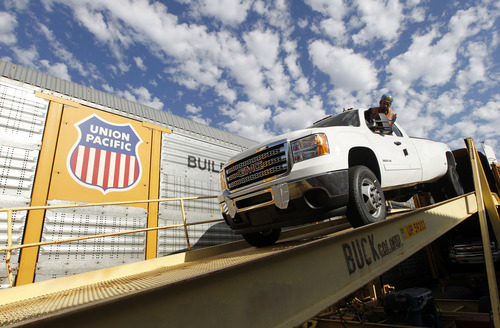
"We ship over 75 percent of all the finished vehicles west of the Mississippi. Three out of four cars at the stoplight came on Union Pacific," said Dan Harbeke, director of public affairs in Utah.
Hauling new cars and trucks is the smallest component of UP's six business groups. The automotive segment provided 8 percent of the $18.5 billion in freight revenue generated by the groups. By contrast, energy — primarily coal — accounted for 22 percent. Next in importance were intermodal shipments, farm products, industrial products and chemicals.
With the exception of North and South Dakota, UP's 32,000-mile rail network extends into every state west of Chicago. Although it doesn't run trains into Canada or Mexico, UP is fast becoming a global transportation company. Harbeke said 40 percent of UP's shipments begin or end outside the United States.
Future of railroads • Arguably the best evidence that railroads are still vital is the behavior of investors. Since fuel prices began their sharp rise in 2004, UP's stock has quadrupled in value, to the $115 range. In late 2009, billionaire investor Warren Buffett announced that his Berkshire Hathaway investment firm would spend $44 billion to buy UP rival Burlington Northern Santa Fe Corp, or BNSF. It was the largest purchase in Berkshire's history.
"It's an all-in wager on the economic future of the United States," Buffett said at the time. "I love these bets."
The BNSF deal apparently worked out. In Berkshire's latest annual report, Buffett said the railroad delivered record operating income in 2011, even though the economy struggled.
Fuel prices are unlikely to fall anytime soon, which works to UP's advantage. BYU's Snow said rail transportation is three times more fuel-efficient than trucks. It's also cleaner. Airplanes are even more inefficient in terms of fuel consumption and greenhouse gas emissions. Rail's chief drawback is speed; trucks and airplanes move things faster, he said.
Trucking companies aren't so sure that railroad companies will siphon off much of their business. For one thing, rail companies will have to expand the size of their track networks in order to increase the amount of freight they can haul — a task that would be physically difficult to pull off, as well as hugely expensive. What's more, customers are still willing to pay for the speed and convenience that trucks offer, said Dan England, chairman of C.R. England, the Salt Lake City-based trucking giant.
"There are a lot of efficiences that go along with railroads, although in terms of service, they are not quite where trucking is. But the biggest constraint is their capacity. They've got only so much rail line, and they can't expand their market share very much," England said.
But, Snow said, old technologies often experience a last gasp that in some cases keeps them alive and beats back newer technologies. Manufacturers have figured out ways of squeezing more performance out of silicon semiconductor chips, which has slowed the shift to faster, but more expensive, gallium arsenide chips.
"I think rail is a lot like this. It's been around forever. I think you'll see rail has an inherent advantage that won't go away quickly," Snow said, adding that UP and other rail companies will use their advantage to develop innovations that chip away at the speed and flexibility advantages that trucks and airplanes have.
And that, presumably, will enhance the appeal of rail further.
"My prediction will be that they continue to increase their already substantial efficiency advantage. These old technologies have a way of fighting back against new ones in novel ways that you can't predict," Snow said.
Twitter: @sltribpaul —
Union Pacific by the numbers*
Territory • 23 states
Miles of track • 31,900
Employees • 44,800
Annual payroll • $4 billion
Capital spending (2011) • $3.2 billion
Locomotives • 8,200
* All figures are for 2011
Source: Union Pacific —
Union Pacific in Utah*
Miles of track • 1,250
Employees • 1,400
Annual payroll • $121.8 million
Capital spending • $62.2 million
Rail cars with loads that originated in state • 302,913
Rail cars with loads that terminated in state • 149,065
* All figures are for 2011
Source: Union Pacific —
Union Pacific, a brief history
1862 • President Abraham Lincoln signs the UP charter
1869 • UP and Central Pacific join rails at Promontory Summit, Utah
1890 • UP emerges as the largest U.S. rail carrier
1897 • E.H. Harriman purchases UP for $10 million
1934 • "City of Portland" sets a coast-to-coast record of 56 hours and 55 minutes
1971 • Rail Passenger Service Act transfers most passengers to Amtrak, allowing railroads to focus on freight service
1996, 2002 • UP carries Olympic torches
2000 • Rails once spiked by hand are now laid with new technology