


This is an archived article that was published on sltrib.com in 2012, and information in the article may be outdated. It is provided only for personal research purposes and may not be reprinted.
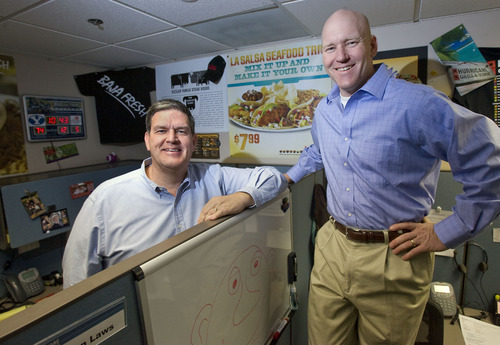
Rich Hanks has a favorite among the more than 100 million customer surveys that Utah-based MindShare Technologies has gathered on behalf of its clients, in 25 industries in more than 125 countries.
"The clam chowder was lukewarm at best," said the customer in a phone survey, "and there were no clams to be found."
"Here's why I like that one," said Hanks, chairman of MindShare of Murray. "More than anything else, it tells what we do."
What the 9-year-old company does is provide almost instant customer and employee feedback to businesses, which include Comcast, McDonald's, Great Clips, Firestone, Arby's and Hertz, and locally, Cafe Rio, Costa Vida and Gastronomy.
So in the case of the clam chowder call, Gastronomy (MindShare's first client) had a new employee at one of its restaurants who had not been properly trained how to ladle soup into a bowl. The customer's complaint was quickly forwarded to the manager, who then made sure the employee knew to stir the chowder before ladling in order to capture the clams that settle to the bottom. No more clamless clam chowder.
MindShare Technologies made Inc. magazine's list of the 500 fast-growing companies in 2008, at 429. Since then, it has made the top 5,000 list, at 1,052, in 2009; 1,723 in 2010; and 2,559 in 2011. Its three-year growth rate from 2007 to 2010 was 91 percent, going from $7.1 million in 2007 to $13.6 million in 2010, according to figures the company supplied to Inc. Revenue in 2011 was $19 million, Hanks said.
—
'We could automate this' • The tepid clam chowder complaint was among the first 300 that MindShare gathered after it was launched Nov. 15, 2002.
Founded by CEO John Sperry and Chief Technology Officer Kurt Williams, Sperry said the idea came to him shortly after the company in which he and Hanks were working closed down earlier that year, during the dot-com bust.
Casting about for a job, Sperry had lunch with a friend who ran a mystery shopping business. Mystery shopping companies contract with other businesses to send in people anonymously to buy products and test services. The Mystery Shoppers then fill out reports that go to the clients, who are looking for feedback on their operations.
"He was telling me this, and I said, 'And you do this by hand?' " Sperry said. "He goes, 'Well yeah, it's a valuable service.' That's when the idea hit. We could automate this … and that's when the idea of MindShare was born."
Hanks was the company's first outside investor and joined MindShare as chairman and president in 2004. He retired as president last week but remains as chairman.
The company inhabits a space in the marketplace that had been dominated by mystery shopping companies for 70 years. Another traditional way of getting customer feedback had been placing comment cards on counters with a box where customers can deposit them.
MindShare founders believed that technology, and today particularly mobile devices, could deliver more and better customer feedback, quicker (nearly instantly) and throughout all levels of an organization.
—
Finding the problem • But the path to becoming a viable company was rocky, Sperry said.
At one point early on, angel investors said the company couldn't get the rest of its promised funds without changing the terms of their agreement, even though the company was negotiating a big agreement with Great Clips, the chain of hair care shops. MindShare owners met with workers and asked whether the company should negotiate for more money on new terms or have everyone go without pay in order to continue.
"They went without pay for six to nine months," Sperry said. "Some employees went without pay for up to 14 months."
Then the Great Clips contract came through, and other angel investors put in more funds.
Things have been smoother since.
MindShare's clients solicit customer feedback in several ways. A call center may ask if the customer will take a survey at the end of a call. A restaurant can use the receipt to offer something free for participating or place a card posted at a table soliciting comments.
Georgette Vlangos, Costa Vida's director of training and communication, said her company entices customers at its 39 restaurants in eight states to participate in the surveys with freebies such as chips and salsa.
Although customers are mostly uncomfortable giving feedback face-to-face, they are less reticent when they can take a survey on their phone or over the Web, she said.
For eateries, MindShare breaks the survey results down into different categories, such as cleanliness, the taste of the food and the quality of the service.
"We can drill down to see specifically what was wrong," said Vlangos. "Restaurant cleanliness for example. Was it the dining room? Was it the serving line? Where did the guest notice an issue or feel we were doing really well."
Customer complaints can be delivered nearly instantly to a store manager.
So, for example, if a customer called on a mobile phone, he or she might be asked if the bathroom was clean. If they pushed "1" for "not clean," they would be asked to say in their own words what was wrong.
"So then you talk: 'I went into the restroom and the sinks were overflowing and the place was a filthy mess,' " said Hanks.
Those types of responses trigger an instant message saying a customer is reporting the bathroom sinks are overflowing, and the manager can dispatch someone to fix the problem.
—
Long-term change • But information also is compiled over longer periods to provide a view of constant problems or trends.
Analysis can be provided for different levels of the company. A district manager could look at all stores in his or her area, a CEO could see a companywide picture, and the data can be sifted down to a single comment.
The company's software analyzes the messages automatically and triggers reports based on what it sees. Tables described as messy, dirty, filthy, sticky or icky can generate a message to the mobile phone of the manager.
Part of MindShare's magic is its ability to take voice calls from customers, analyze what they are saying and reproduce the voice calls as text that is analyzed and can be transmitted to clients. The technology is based on IBM's Watson computer, such as the one that played and won "Jeopardy!"
In addition to the reports on customer comments, MindShare also can recommend that managers make improvements in stores operations.
Store and restaurant managers often are too busy to step back and take a look at what they might do to make improvements, Hanks said, so MindShare can take company policies and use them as a guide to make recommendations for actions.
MindShare charges $40 to $100 per location per month for its services. Its profits are possible because of the high degree of automation.
MindShare also takes employee feedback for businesses and can subject it to the same analysis tools as customers input.
Twitter: @TomHarveyStrib #uttech