



This is an archived article that was published on sltrib.com in 2013, and information in the article may be outdated. It is provided only for personal research purposes and may not be reprinted.
It's the middle of Lent and even the sound of a pop can opening reminds Alisa Bolander what she gave up — Coke Zero — during her 40-day preparation for Holy Week.
Focusing on her soul, rather than her taste buds and daily habit, has been especially meaningful for the Mormon mom this season of mourning, having lost her 64-year-old father two months ago. The discipline reminds her that mortal life is temporary and that light eventually follows darkness.
Unlike most Mormons and the church itself, Bolander has been observing Lent for the past few years, prompted by disappointment at hearing no mention of Jesus Christ during her LDS congregation's 2009 Easter Sunday services.
The miracle of the empty tomb was "completely ignored and forgotten. It didn't make it into the lessons, testimonies or even hymns that day," Bolander, of Sandy, recalls. "I decided I needed to go somewhere else."
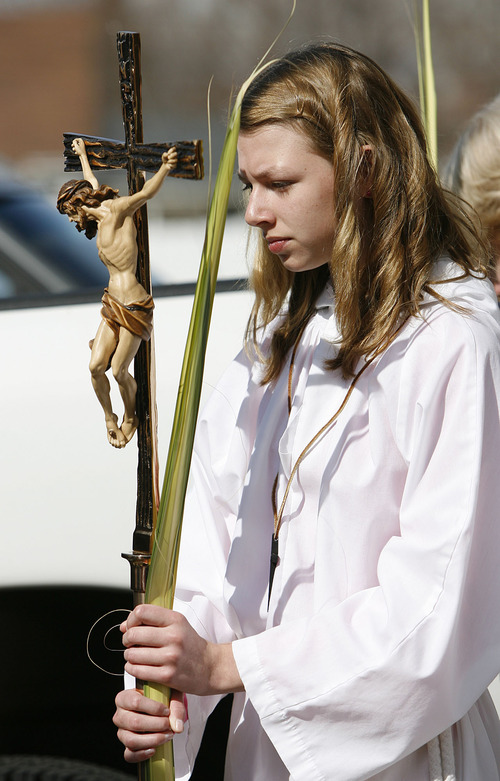
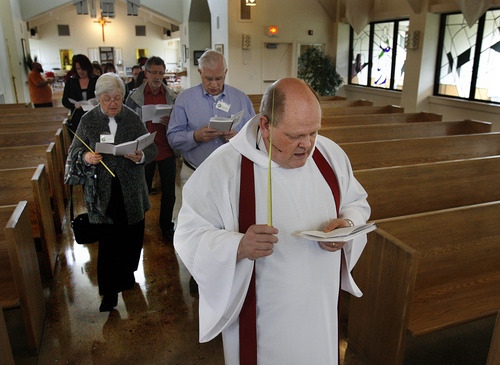
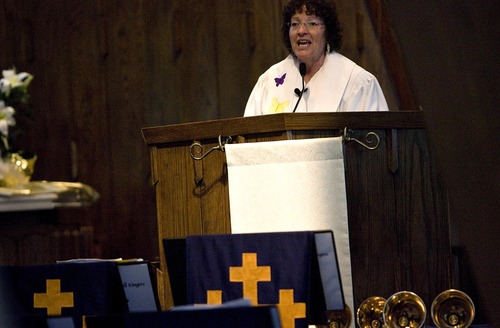
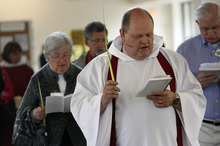
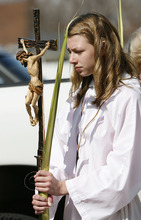
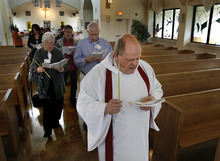
Since then, this devout Mormon has enjoyed participating at Holladay United Church of Christ in traditional Passion rituals, including Palm Sunday, Maundy Thursday/Good Friday, Saturday Vigil and Easter Sunday.
"It takes you from Jesus' triumphant entry into Jerusalem through the Last Supper and Crucifixion, from hailing [the Son of God] to abandoning him at his most vulnerable," Bolander says. "Such range of emotions is a really good and deeply Christian experience. As a Mormon and Christian, I need to have that experience."
Now more and more members of the LDS Church are eagerly seeking the same feelings, so they have turned to the Lenten mainstays of traditional liturgical Christians.
Some are converts from Catholicism and various Protestant denominations who miss the rituals of their former faiths. Some are lifelong Mormons yearning for a richer way to anticipate and hallow their belief in Jesus' rebirth.
They say Lent helps them focus on their Savior's sacrifice, be mindful of a confining habit, embrace the community of Christians and relive the agony of Christ's last week, rather than just hearing about it.
—
'Creeping ecumenism' • Increasingly, members of other nonliturgical Protestant faiths — Methodists, Presbyterians, Congregationalists and American Baptists — also are finding value in these Holy Week rituals, says historian Jan Shipps.
This is "creeping ecumenism," says Shipps, a retired professor of American religion at Indiana University-Purdue University Indianapolis, "not in doctrine or theology but in ritual."
Mormons and Protestants are no longer isolated among their own, but, through friends, neighbors, co-workers and social media are discovering that Easter-related practices, she says, "do bring you closer to your spiritual life in a way that is surprising."
As a Methodist growing up in the Bible Belt, Shipps and her family did not participate in Holy Week services.
"Lord no!" she says emphatically. "People would have thought we were about to turn Catholic."
Back then, Shipps says, most Protestant services were about prayer, preaching, testimony and hymn singing.
That's because Reformers broke away from Catholicism partly as a critique of its ritual excesses.
Protestant worship has a "leanness to it, a spareness, a restraint," says Philip Barlow, chair of Mormon History and Culture at Utah State University. "It leans toward austerity compared to the richness of Catholic and Orthodox traditions."
Mormonism, which emerged in 19th-century Protestant-dominated America, Barlow explains, "inherited part of that."
Latter-day Saints think they note Easter, Barlow says, but their "idea of celebration is a church talk on resurrection or Christ's atonement."
Mormons might be able to honor the day more fully, he says, "if we had some analogue to Lent, if we were ritually conscious of the events leading up to it."
Members of the Utah-based LDS Church, Barlow says, tend to "leap right to resurrection and pay scant attention to darkness or crucifixion."
—
Lack of liturgy • There's no question that not having any visible or unique Easter services adds to the charge that Mormons aren't Christian, says LDS scholar Roger Keller.
"It has led others to wonder about the nature of our Christianity," says Keller, who retired last year as Brigham Young University's Richard L. Evans Chair of Religious Understanding.
Keller, who was a Presbyterian minister in Mesa, Ariz., before joining the LDS Church, understands the historical reasons behind Mormonism's lack of an Easter liturgy.
"We've avoided some of these holidays because we don't want to look like a Reformation church. We want to underline our belief that [our form of Christianity] is something very old but also new."
Mormonism maintains that it is a restoration of Christ's original church, stripped of centuries of tradition.
Still, Keller misses some of the liturgical practices of his former church. He has been called by his congregation to work on "interfaith relations" and, in that capacity, will join in Holy Week services in Marshfield, Wis., where he now lives.
Keller senses a desire among the younger generation of Latter-day Saints "to express their faith more visibly."
Stephanie E. J. Long began her Lent practice when she was 22 and interning with LDS Church magazines in downtown Salt Lake City.
"I remembered all of my friends through the years who had made that 40 days' sacrifice and how much I had admired them, and I felt that is what I needed to do," she writes in an email. "So, during my lunch break, I marched myself from the LDS Church Office Building to the Cathedral of the Madeleine for the Ash Wednesday service, and I decided to give something up that day until Easter."
She chose to forgo potato chips, which seemed trivial, she acknowledges, but at the time "felt it was fitting and a proper test for me."
Since then, what Long, a single Mormon professional living in New Oxford, Pa., has given up for Lent has changed, but the discipline remains the same — focus on "Christ, sacrifice and what Easter is all about."
—
Different than dieting • Diane Tueller Pritchett, a former LDS Relief Society president in Boston who now lives in India, wanted her Lenten fasting to seem different than dieting.
"I give up something different every year — sometimes it is a food-related practice, sometimes it is a habit, sometimes it is a personality trait. Sometimes I add something to my life that I feel would enhance my spiritual life," Pritchett writes. "One year I decided to write one thank-you note a day to someone I had on my mind during Lent. One year I gave up speaking ill of others (that was hard)."
She tries to make the experience challenging, she says, "so that every time I'm tempted to do [something I promised to forsake], I have to pause and think about WHY I'm doing it."
Linda Hoffman Kimball, a writer and illustrator who spends half of every year in a home near Kamas, joined the LDS Church as a teen. Though committed to her new faith, Kimball brought with her Protestant rituals, she says, that had "nourished me spiritually before."
Kimball, author of Muffins and Miracles: Church Service in the Real World, doesn't always do Lent, but whenever she does, it is satisfying.
One year she gave up looking for deals on eBay; another time she "eschewed soda drinks."
"The most significant Lenten experience was the year I decided to 'give up envy' — although Lent isn't really about giving up; it's more about embracing something richer," Kimball says. "I learned that year how pervasive envy is and how riddled I was with it. … It was a great lesson on grace and my need for help beyond my own."
Kimball, Pritchett and several others mentioned they do not like it when the April LDS General Conference coincides with Easter. The two-day Mormon event is broadcast from Temple Square in Salt Lake City to church buildings and homes across the world. It mostly features sermons by church authorities. Some Latter-day Saints are able to attend in person, but most Mormons watch the proceedings passively on a television or computer screen.
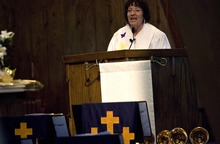
When there's overlap, these Lent-observing Mormon faithful sometimes skip the big LDS meeting to sneak into the nearest white-lily-bedecked cathedral, and to listen, enraptured, as the trumpets (which generally are not allowed in Mormon services) symbolically sound the Christian claim, "He is risen!"
pstack@sltrib.com, Facebook.com/peggy_fletcherstack, Twitter: @religiongal