

This is an archived article that was published on sltrib.com in 2012, and information in the article may be outdated. It is provided only for personal research purposes and may not be reprinted.
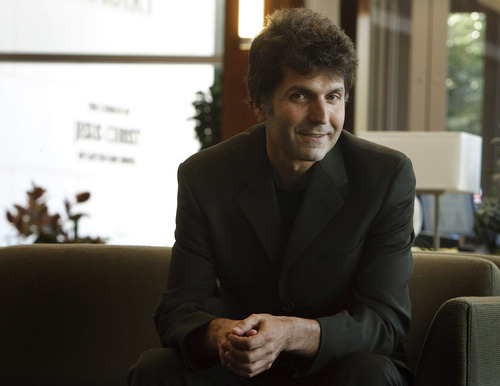
As an 11-year-old boy, Don Bradley went looking for gold plates.
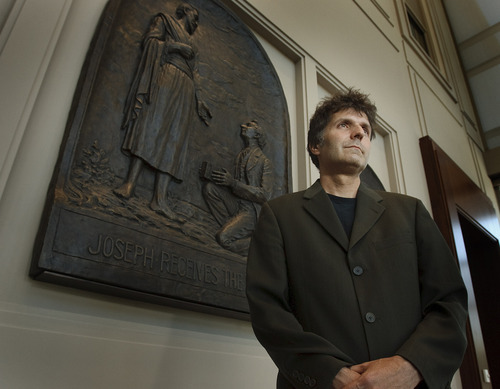
After all, Mormon founder Joseph Smith said he was directed to a set of such plates, buried in a hill near his house in upstate New York.
On a childhood visit to that hill, Bradley turned over lots of rocks, feeling certain he might find some sacred record overlooked by others.
He never did.
That quest for Mormon gold became a metaphor for Bradley's lifelong spiritual journey. It led him first to dig into Smith's history to enhance his LDS devotion and then to uncover uncomfortable facts and omissions in the faith's story, which bred disillusionment and distance.
Eventually, Bradley's research helped bring him back to the Mormon fold, this time with a broader view of Smith's spiritual abilities.
"I could describe many of the events of Joseph Smith's life, but I couldn't explain the thing that really mattered: why it all worked," Bradley, now 42, said in a July speech at the annual Sunstone Symposium, a conference in Salt Lake City for Mormon intellectuals. "Joseph Smith wasn't of interest because he'd been a merchant, a mayor, or even a much-married husband, but because he was the founder of a religion. And it was precisely the religious dimension I couldn't account for."
Besides rediscovering Mormonism, Bradley learned how to balance faith and facts, science and spirituality, reason and revelation.
Along the way, he spent time as an agnostic and atheist, then back to theist, then Baha'i, then generic Protestant before returning to the Utah-based church where he had begun.
"I overthink things," Bradley said with bemused understatement. "I saw that I'd often done this, to my detriment. … I'd been trying to solve spiritual questions with the tools of history."
Could part of the problem be, he wondered, "that spiritual questions can't be resolved by scholarly analysis?"
—
Searching for God • Bradley's parents were Mormon converts who reared their family first in Baltimore, then in South Bend, Ind., before moving to Utah when Bradley was a teen.
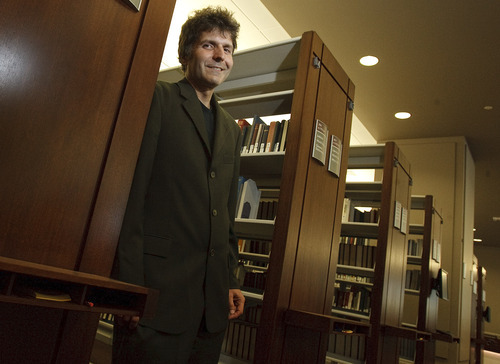
With proximity to the LDS Church archives and library, the would-be historian spent countless hours after school poring over documents, mining every nugget about the church's past.
"Being a historian is like being a detective," Bradley, now living in Provo, said this week in an interview, "except all your witnesses are dead and you have to piece it together based on clues left behind."
It was going well until 11th grade, when he found an analysis of potential problems in the Book of Mormon by a famed LDS scholar/general authority, B.H. Roberts, at a Deseret Book store.
"It turned me upside down," Bradley said. "If this had been written by someone clearly antagonistic to the church, I would have had my guard up. But I knew [Roberts] was a general authority and church historian. I trusted him."
Roberts' questions about the historicity of Mormon scripture troubled the young seeker, but he stuck with the faith. He served an LDS mission to Houston from 1989 to '91, encountering many perspectives and people of all faiths.
"I came back more open-minded," he said, "and a much more critical thinker."
He again took up his Mormon pursuits, majoring in history at Brigham Young University.
"I had a few evidences that I thought were sufficient foundation for my continuing belief," Bradley recalls, "then I picked those apart."
He began to look cynically at all LDS accounts while rejecting religious experience as an avenue to truth. Yet faith built on historical evidence alone, he felt, was untenable.
Using the Joseph-as-fraud model, Bradley examined Smith's statements with the question: "How could this benefit him?" Not surprisingly, he found lots of supporting evidence.
The historian determined he no longer could be, in good conscience, a Mormon. He also abandoned all belief in God and Christ.
On Pioneer Day 2005, Bradley delivered a letter to his LDS bishop, resigning his membership with such strong language that he believed it would be impossible for him to return.
He was wrong.
—
Epiphanies large and small • In 2009, Bradley was accepted into Utah State University's graduate program in history, with Mormon scholar Philip Barlow as his mentor.
Barlow spotted Bradley's gifts immediately.
"Intellectually, Don is uncommonly brilliant," Barlow said this week. "In a roomful of Ph.D.s, he'd be among the smartest and most well-read. His writing and the thinking behind it are superlative."
Barlow also sensed Bradley was not a believing Latter-day Saint, though they never talked about it. It was irrelevant to his academic research.
Even before his graduate studies, however, Bradley had yet another awakening.
It happened while reading Biocosm, atheist author James Gardner's discussion of the origins of the universe without God.
"I'd thought the chance of a universe fitted for life was something like one in a billion," Bradley said in his speech. "The reality was more like one in 10 to the 200th power."
Gardner's answer to that improbability?
"The constants of the universe were shaped by our distant descendants, who engineered the collapsing universe to restart," Bradley said, then asked incredulously, "He thinks this is more likely than God?"
The moment was as shattering to his unbelief as Roberts' questions had been to his LDS faith.
In that instant, he again became a believer — at least in God.
From there, he moved into a general theism, then to the Baha'i faith.
"I wasn't sure about its founding claims," he said, "but I loved its teachings about the oneness of humankind. That was the kind of vision I believed God would want us to live out."
A few months later, another event would upend his world even further: His 25-year-old brother, Charles, died unexpectedly.
Bradley's views on the afterlife "were sketchy and uncertain," he said, but he couldn't imagine never reconnecting with the brother he adored.
"I was drawn to the only hope I could see that Charles, not just some aspect of him, but my brother, would live on: the hope of resurrection," Bradley said. "Re-examining the claim of Christ's resurrection, I … became persuaded that God had raised Christ."
He tried to ground his faith solely in the Bible, but that seemed impossible. Christianity's sacred book does not offer a single, easy-to-grasp set of beliefs; it has to be interpreted through some kind of lens. He chose a vague kind of Protestantism.
As Bradley returned to devotional life, he felt drawn to the one book he knew would bring him even closer to Jesus: the Book of Mormon.
"I didn't believe in the Book of Mormon per se," he said, "but if it had worked so well for me before, why not use it now?"
So he become a devoted, though not believing, Mormon.
—
Faith reawakened • At USU, Bradley worked on a little-studied element of early Mormonism — the first 116 Book of Mormon pages, which Smith said he translated and shared with a friend, who then lost them.
Bradley found primary and published documents that described the lost content and, piece by piece, he began to see more clearly Smith's grander vision for his restored Christianity.
"Using my same historical-critical methodology I found things … good things, that bowled me over," he said. "I discovered that Joseph Smith's early religious claims and texts already anticipated Nauvoo Mormonism, and that his early prophetic narratives displayed a complexity, power and intricate relationship with the Bible beyond what I could grasp a teenage boy coming up with."
While looking for reasons to believe that Smith was an opportunist after money, sex and power, Bradley found a number. But when he sought examples of how the Mormon founder benefited others and served religious purposes, he found even more.
He could now re-embrace Smith, not in a simplified way but as a complicated man capable of revealing God's messages to the world.
"The questions we ask largely determine the kinds of answers we find," Bradley said. "I had pushed the cynical interpretation as far as it could go, tried to explain as much as I could using that model, only to find the model ultimately deficient. It could not explain the spiritual power of Joseph Smith and of the faith he founded. … I have no doubt, on historical grounds alone, that Joseph Smith is vastly bigger than the cynical caricature of him and that he was a sincere seeker after truth and a magnanimous soul."
At the same time, Bradley regained his faith in the validity of religious experience and a church's good works.
Bradley's longtime friend Trevor Luke, who teaches classics at Florida State University, saw this transformation.
"He really believes that he's experienced the presence of God," Luke said. "At one point in time, he tried to explain it away, but when he looked back, he saw that it was a miraculous event and he wasn't going to reject it."
Not sure what to do, Bradley met with an unknown neighbor who would be his current bishop. The man was nonjudgmental and welcoming, telling him he would have to answer the questions he had asked in his resignation letter.
Oh, yes, and go through the lessons with 19-year-old missionaries — like Bradley used to be.
Though approaching the experience as a kind of anthropologist, Bradley said, "I experienced something my own investigators had described, that during the discussions and after, there was a light with me."
Five months after Bradley rejoined the faith, he was invited to work on the church's "Joseph Smith Papers" project, he said. All his temple and priesthood blessings were restored.
"In the eyes of the church, it was as if I'd never left," Bradley said in his speech. "I can tell you with certainty: It is a gospel of forgiveness."
Barlow was surprised to get an invitation to Bradley's rebaptism into the LDS Church but had noticed subtle changes in his student's tone and approach to Mormon history.
"We didn't discuss his religious faith," Barlow said. "But we did talk about how you assess evidence."
Barlow sees Bradley's path as sincere and deep, with an uncompromising approach to matters of faith and reason.
There was an integrity to his leaving, Barlow said, "as well as in his coming back."
And the rest, for Bradley, is history.
Facebook.com/peggy.fletcherstack
Twitter: @religiongal