










This is an archived article that was published on sltrib.com in 2010, and information in the article may be outdated. It is provided only for personal research purposes and may not be reprinted.
A tiny smile appeared on Elizabeth Smart's face Friday morning as Brian David Mitchell was pronounced guilty of kidnapping her when she was 14.
The smile grew as a U.S. District Court clerk announced jurors had also convicted Mitchell of transporting her across state lines for the purpose of engaging in sexual activity.
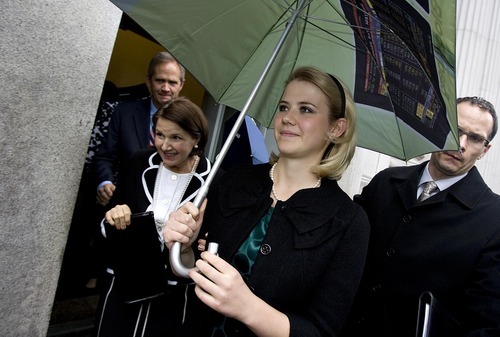
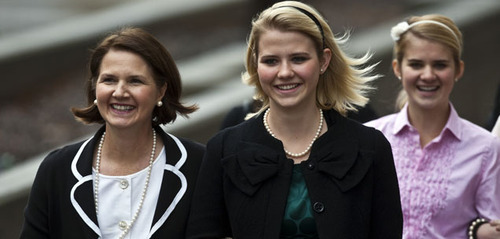
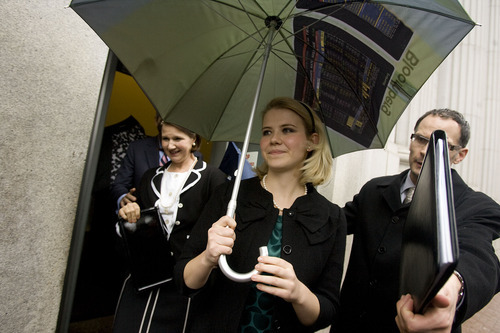
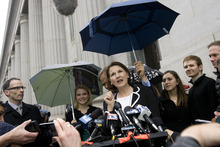
Moments later, as Mitchell was led singing from the courtroom for one final time during the five-week trial, the 23-year-old Smart was nearly beaming as she stood with her parents, Ed and Lois Smart.
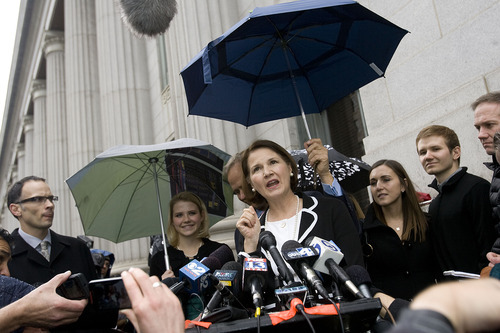
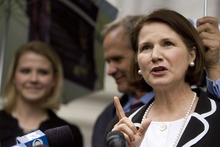
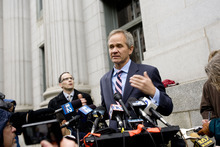
Elizabeth Smart later triumphantly told a small army of reporters assembled outside the federal courthouse: "I am so thrilled with the verdict. But not only that, I am so thrilled to stand before the people of America today and give hope to other victims who have not spoken out about what's happened to them."
Thanking the public for their prayers and support, Smart added she hoped her experience shows that "it is possible to move on after something terrible has happened, and that we can speak out and we will be heard."
Mitchell's convictions end an eight-year saga that has left its mark on Utahns. Thousands of citizens mobilized to search for the missing Salt Lake City girl — a process that inspired later large-scale searches for other missing children. The Smarts never gave up hope, although many presumed their daughter was dead and were astonished when she was found nine months later in the company of Mitchell and his wife, Wanda Eileen Barzee.
Smart's parents said Friday they were grateful their daughter survived a knife-point abduction, near-daily rapes and many other humiliations at the hands of the 57-year-old defendant. They also said they were proud she testified so courageously about her nine-month ordeal, which included a trip to California and back.
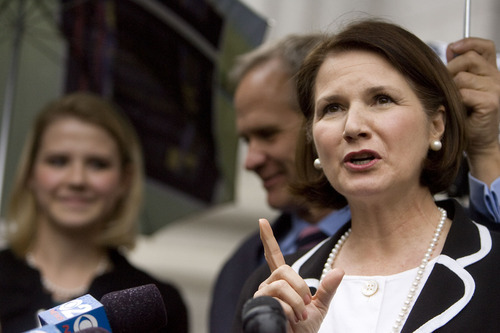
"Doesn't she glow?" Lois Smart asked the crowd, following Friday's verdict.
She added, "I think this is an exceptionally victorious day for us all, as mothers, as women, as daughters. ..."
Lois Smart noted that her youngest son was just a toddler when his sister was kidnapped from their home in the early hours of June 5, 2002. "He is now 12, and this has been his entire life, so we're glad it's over," she said.
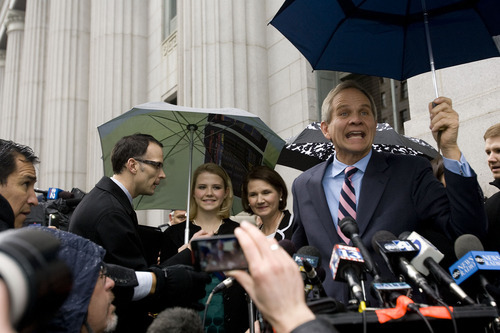
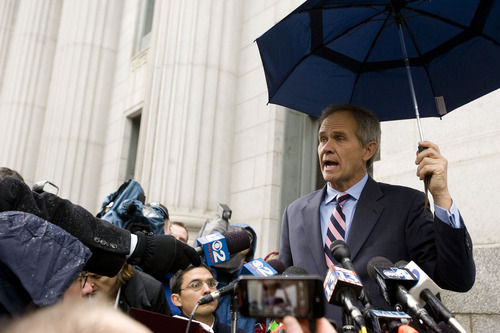
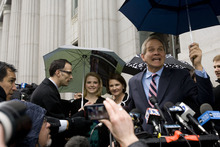
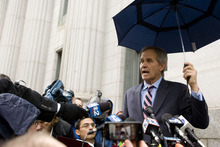
Ed Smart said of his daughter: "She is home; she is well; and the system works."
Smart plans to return to France next week to complete her mission for The Church of Jesus Christ of Latter-day Saints. But her church duties will be finished in five months, her father said, and she plans to attend Mitchell's May 25 sentencing before Judge Dale Kimball.
Mitchell faces up to life in prison.
Friday was the only time during the 21-day trial that Mitchell has not been ejected from the courtroom for singing hymns. Defense attorney Robert Steele attempted to quiet Mitchell on this occasion by whispering, "Please stop singing."
Instead, eyes closed and hands clasped as if in prayer, Mitchell sang louder as the judge entered and began addressing the court, and as court clerk Kim Jones later announced the verdicts.
The hymns referred to the crucifixion of Christ, which may be apt choices given that Mitchell believes he is being martyred in Christ-like fashion by the government, according to trial testimony.
A five-woman, seven-man jury convicted Mitchell after three hours of deliberation on Thursday night and another two hours Friday.
Steele had urged jurors to find Mitchell not guilty by reason of insanity. He claimed his client was severely mentally ill and acting under the delusional belief that God had ordered him to abduct Smart to make her a plural wife.
Barzee had testified that Mitchell had revelations that he would take at least seven plural wives and battle the anti-Christ to restore the Mormon church to its true polygamous beginnings. Prior to abducting Smart, Barzee said, Mitchell had a revelation telling him to acquire wives by taking young girls by force.
Several jurors said during a post-verdict interview with reporters that they believed Mitchell was mentally ill but did not find he suffered from a "severe" mental illness, which is required for an insanity defense. The jurors also found Mitchell knew right from wrong, which exempts him from claiming to be insane.
"If God said to go get her, would he dress in black with a buck knife instead of his religious robes?" said one of the jurors. "I did feel this guy has got a mental illness — it's not normal to walk across the country [pulling] a cart — but I do think he knew what he was doing was wrong and against the law."
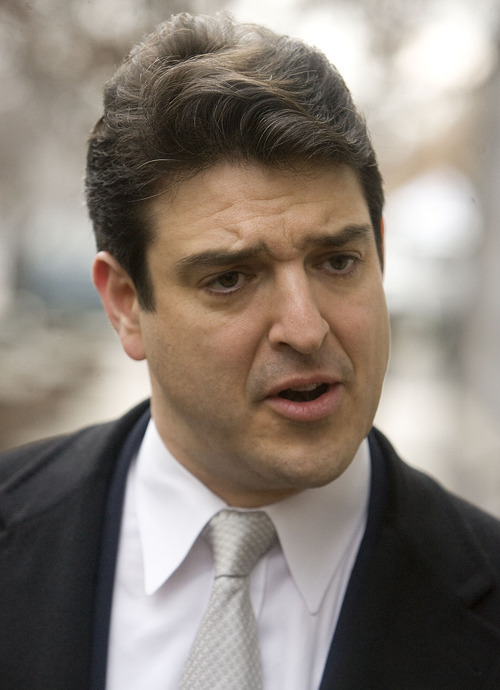
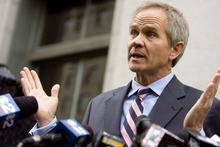
U.S. Attorney for Utah Carlie Christensen called the verdict "a very historic and momentous day in the criminal justice history of this state."
Christensen also said she was impressed with the extraordinary courage and determination of Smart and the "candor, clarity and truthfulness" of her trial testimony.
During her three days of testimony, Smart told jurors the graphic details of how Mitchell sexually assaulted and degraded her.
With the trial over, the possibility of an appeal is looming. But Steele said any appeal would address Kimball's refusal to move the trial to another state, rather than any potential errors that occurred during the trial. The defense had asked for a change of venue early on, claiming Mitchell could not get a fair trial in Utah due to intense publicity about the case.
But Steele added that he questions the wisdom of putting Mitchell through another trial "where the standard is so high, no matter where you are." He noted that, contrary to other criminal proceedings, the defense has the burden of proof in insanity cases.
Had the jury found Mitchell insane, he would be going to a secure mental facility rather than prison.
Rebecca Woodridge, a former stepdaughter of Mitchell's who claims he sexually abused her for four years starting when she was 7, said she was afraid for his safety in a prison setting and doesn't understand how the jury didn't realize he is mentally ill.
"I don't know if there is help for him, but they can at least put him in a place where he can be safe," Woodridge said.
Woodridge, who says she has forgiven Mitchell, started crying upon hearing the verdict and said she felt nauseated. But she also said she was happy for the Smart family.
"They got the verdict they wanted," Woodridge said. "I am sorry for what [Smart] went through."
Doug Larsen, a former co-worker of Mitchell's who testified in and later attended the trial, said: "Thank God. I'm grateful he was found guilty on both counts."
Larson said Mitchell "wasn't going off the deep end" as far as he knew when they worked together at OC Tanner in the early 1990s. Larsen testified he and Mitchell were almost as close as brothers but didn't see each other for several years after Mitchell left the company.
When he spotted Mitchell begging for money in downtown Salt Lake City in 1998, his old friend denied knowing him, Larsen said.
Larsen said that defense attorney Steele told him Mitchell was grateful that he showed up at the trial. Steele told reporters that Mitchell — who was able to watch the trial on a TV located outside the courtroom — was "very aware of witnesses that he knew."
"He's not disconnected," Steele said. "It was interesting to him to hear from his family. But he is disinterested in the trial process."
Steele said he talked to Mitchell on Thursday night and Friday morning. He said they have had "very rational discussions and some very odd discussions."
A mental health expert called by the defense testified Mitchell suffers from delusional disorder, a rare illness where his delusions are encapsulated and triggered only by religious ideas. Another defense expert claimed Mitchell suffers from paranoid schizophrenia.
But prosecution experts said Mitchell did not suffer from any severe mental illness. Rather, they said, he is a pedophile and a psychopath, who also has anti-social and personality disorders.
Ed Smart said he and his family planned to "celebrate" the verdict this weekend.
Smart's return to her Federal Heights home on Friday afternoon was subdued compared with her March 12, 2003, homecoming. Police rescued Smart after she was spotted with Mitchell and Barzee in Sandy after the trio had returned from spending the winter in San Diego.
Following Smart's rescue, neighbors lined the street with blue balloons and ran into the street to celebrate.
On Friday, Smart shared smiles and hugs with a neighbor who happened to be outside, and then went inside. But the blue balloons did make another appearance.
Daisy Carlson, a neighbor of the Smarts and a family friend, tied a bunch to the railing in front of the Smart home in the same manner she had decorated the street when Smart was found. She said she also brought blue and white lilies, so that "Elizabeth can be at peace now."
"I did this years ago for her, and I wanted to do it again," Carlson said. "I just wanted her to relive the joy of the moment when she came home."
Tribune reporters Cimaron Neugebauer, Katie Drake, Pamela Manson, Sheena McFarland, Bob Mims, Melinda Rogers and Dan Weist contributed to this report. —
Q&A
How much time could Brian David Mitchell spend in prison?
Up to life. Since there is no parole in the federal system, Mitchell would not be freed if a life sentence were imposed. If he receives a lesser sentence, he can earn up to 54 days off a year for good behavior.
How will the judge decide?
A federal probation officer will write a presentence report for U.S. District Court Judge Dale Kimball to review. The report will include details about the crime; its impact on the victim, Elizabeth Smart; Mitchell's criminal history; whether he accepts responsibility for his actions; his family history; his physical, mental and emotional health; any history of drug or alcohol abuse; his education and work history; and his financial condition and ability to pay any fines.
Kimball will consider the report and federal sentencing guidelines. He must also give Mitchell, his attorney, the prosecutor and Smart the opportunity to speak.
Where will Mitchell serve his time?
Kimball can recommend where Mitchell should serve his time, but the federal Bureau of Prisons has the final call. There are no federal prisons in Utah, so Mitchell will be placed in an out-of-state facility.
The factors that will determine Mitchell's placement include the level of security and staff supervision he requires; the medical care he needs; and his program needs, such as substance abuse treatment and medical or mental health care.
Administrative factors — the bed space available at a prison, Kimball's recommendation and necessary security measures — also will be considered by the BOP.