If Brenda Case Scheer gets her way, she will oversee the nation's first attempt to renovate a large building into one that is so energy efficient, its carbon footprint disappears.
Her first step might be to banish the 50 refrigerators tucked into corners and cubicles throughout the University of Utah's architecture building, which students use 24/7.
A consolidated kitchen would eliminate the need for pocket kitchens hidden in the studios, which course with electrical wires and boost the building's "plug load" through the roof, says Scheer, dean of the U.'s College of Architecture + Planning.
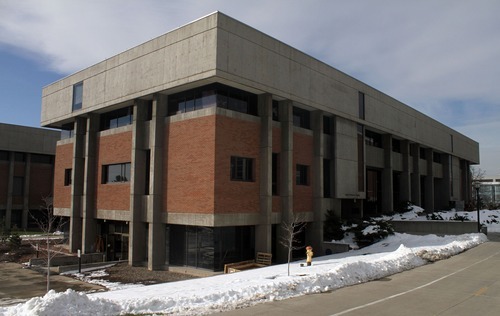
The school occupies the 48,000-square-foot eastern half of the 1970s Art and Architecture Center just south of Marriott Library. It was built at a time when energy was cheap and carbon emissions were of no concern, and it has never been renovated. University officials' goal for a retrofit go far beyond replacing the single-pane windows and dated heating, ventilating and air-conditioning system: They want to cut the building's energy use by up to 85 percent.
"Big statement" • "It's going to help the students realize the point of sustainability," says Tami Beck, an architecture graduate student representing the college on the student senate. "By doing this, we are making a big statement to the community [that] we are pushing the direction where architecture is headed."
As many buildings its age, the center isn't insulated and its ventilating system blows so hard that it pressurizes the building and pushes the doors open. In winter, hot spots abound, and some corners are cold in summer. The ample glass windows hemorrhage heat, yet natural light doesn't reach many areas.
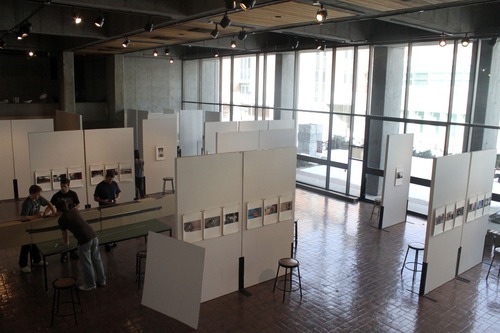
Much improvements will come from easy fixes such as installing double-pane windows that can open and skylights to illuminate the open studios on the third floor.
Buildings account for 40 percent of the energy used in the United States, said Mark Frankel of the New Building Institute, an energy-use think tank based in Vancouver, Wash. Retrofitting the existing buildings is critical to reducing the nation's energy use, and the U. Art and Architecture Center will serve as a good test case of how far a university can go in fixing a deficient structure.
"There's a lot of work to do, and there are some significant challenges there. They'll have to be very aggressive to achieve the efficiencies for it to be demonstrative," says Frankel, who spent countless hours in the U. architecture building as a graduate student.
Not cheap • Meeting the college's goal will become increasingly expensive as easy fixes are completed.
"To really get to net zero, you have to push the technology and management of the building so you have the greatest energy efficiency possible. Some of that would come at a premium," says Cory Higgins, the U.'s director of plant operations.
But it's a premium worth paying because the U. is a teaching institution and much can be learned about how to remake old buildings into models of energy efficiency, even if the college fails to achieve its net-zero goal.
"It's a great initiative. Someone will benefit from that learning," Higgins says. "I'm interested in what they learn because it's only one of 200 energy-inefficient buildings on campus."
Scheer figures the university spends $300,000 to $400,000 a year on the architecture school's energy use, but she isn't sure her proposals would ultimately pay for themselves because there's no way to predict what energy prices will be in 10 or 20 years.
"Our costs are relatively low because the university buys energy in bulk, so our numbers don't look good right now. But if energy costs triple, we are golden," Scheer said.
The cost and feasibility of achieving net-zero status are the subject of an ongoing study.
"What happens if we don't do this? At some point, we have to tear it down," Sheer says. "That's a waste of a huge amount of what we call 'embodied energy' in the concrete. The most efficient building is the one that is already built."
But saving money isn't the entire point of the net-zero project.
"For us, it's a moral obligation to demonstrate a project like this in a 1970s building. There are thousands of buildings like this around the country," she says. "We want our students to be familiar with this."
The renovation would include a 20,000-square-foot addition, probably off the north or south end. Since the building opened, the college has grown from 200 to 600 students, making space tight. But Scheer has no intention of gutting the building, a superb example of the "brutalist" style popular in the 1960s, and rearranging its interior spaces. Its concrete and wood require no paint, and its Bailey Gallery is one of the most engaging open interior spaces on campus.
"The materials are durable, which is one of the mainstays of being sustainable," says Robert Young, an architecture professor and expert in re-use of old buildings.
College of Architecture + Planning Building
R The U.'s architecture school intends to renovate its 48,000-square-foot home into a "net-zero energy" building. The 1970s concrete structure consumes excessive quantities of power and heat. Brenda Case Sheer, the school's dean, hopes to slash the building's energy use by up to 85 percent by upgrading windows, mechanical systems and lighting and reducing the school's electrical use, then meet the rest of the building's energy needs through renewable sources. The project has won federal assistance from the U.S. Department of Energy.