




This is an archived article that was published on sltrib.com in 2012, and information in the article may be outdated. It is provided only for personal research purposes and may not be reprinted.
It took no time at all for the cross hairs to shift from the abruptly ended political career of Sen. Bob Bennett to that of Utah's longest-serving member of Congress.
But tea party Republicans have found it far more difficult to bring down Sen. Orrin Hatch, though he's not out of electoral danger just yet.
Two years removed from Bennett's ouster at the hands of angry state delegates, Hatch left Utah's GOP convention on Saturday in a position of power.
He came just 32 votes shy of claiming the nomination outright and now enters a two-month primary campaign as the clear favorite against former state Sen. Dan Liljenquist.
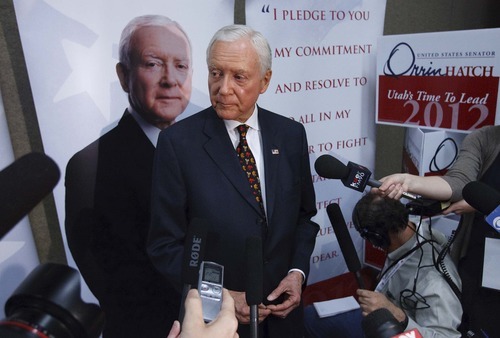
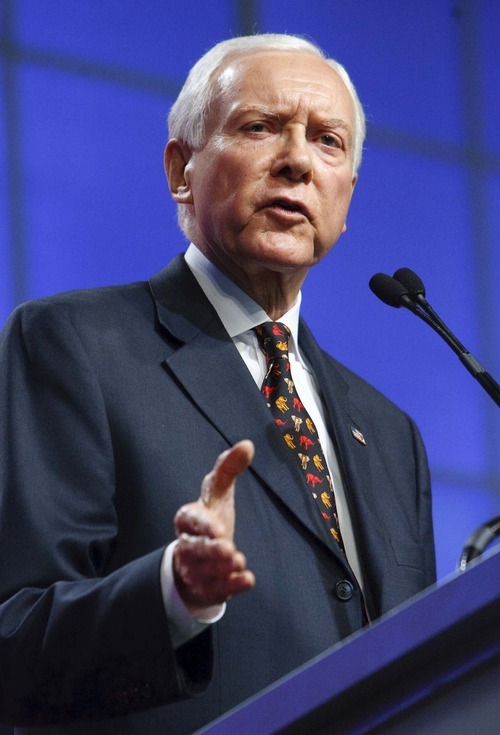
"We're elated we did as well as we did," said Hatch, who is seeking a seventh term in office. "Just a couple months ago, people weren't giving me much of a chance."
So what happened?
Here are six reasons for this political turnaround, starting with the most simple:
He recognized he was in trouble and responded.
Hatch started reaching out to disaffected Republicans even before Bennett lost, probably because his pollsters found the same thing The Salt Lake Tribune did in the days before the 2010 convention: 71 percent of the delegates wanted Hatch booted from office.
The senator's understated response: "Naturally, we're concerned."
He had breezed through five re-election efforts, but he knew his sixth could be a disaster.
"If we had to face the same delegates in 2012 that were there in 2010, Senator Hatch would be toast," said David Hansen, his longtime campaign manager, who developed an unprecedented and expensive strategy that involved a staff of more than two dozen people nearly a year before any challenger actually entered the race.
This team contacted more than 100,000 Republicans around the state, identifying 5,000 people willing to go to their neighborhood caucus meetings and run to be state delegates. It cost more than $3 million.
Friendly organizations not only helped Hatch raise that money but also funded the state Republican Party's campaign to boost caucus attendance.
Hatch also was helped when the LDS Church pressed its members to attend the caucuses.
All of the outreach worked. More than 120,000 Utahns attended the GOP caucus meetings, a massive increase from years past. As a result, seven out of every eight delegates were new.
"These elections to a certain extent are won or lost on caucus night," said Greg Hopkins, Bennett's former campaign manager. "And Hatch had a big win on caucus night."
He made attempts to neutralize the tea party.
Hatch tried to recruit tea party notables to join his campaign. He had success with Evelyn Call, Michelle Scharf and Julian Babbitt but was rebuffed by others, none more prominent than David Kirkham.
The senator spent months building ties with Kirkham, who helped found and fund the Utah tea party, calling him regularly and asking for his advice on votes. He even invited Kirkham, a specialty car manufacturer, to testify before a Senate committee. But right after the hearing, Kirkham announced that he, like most of the Utah tea party, would oppose the senator.
The Hatch campaign saw similar mixed results when it came to prominent outside groups that had battled against Bennett.
In mid-2011, the Club for Growth paid for a TV ad attacking Hatch; the group was itching to jump into the contest. It never did, though Club spokesman Barney Keller said it is still considering an anti-Hatch drive.
Hansen takes some credit for the Club for Growth's absence, saying Hatch supporters "worked on some of their folks to explain to them that Hatch wasn't really against what they wanted."
Hatch also hired Jason Powers, a political consultant who ran the Club's efforts against Bennett.
Keller, the Club spokesman, denies that these moves influenced the group's decision.
The Hatch campaign also tried to talk FreedomWorks out of campaigning against him, even getting one of their board members to endorse him. It didn't work.
FreedomWorks spent more than $700,000 opposing Hatch, much of it on direct-mail pieces that argue he has expanded the size of government. And FreedomWorks plans to continue its drive during the primary race.
Hatch's team has tried to marginalize FreedomWorks as an out-of-town group attempting to sway Utah's election. But the group says it has the backing of thousands of Utahns who want to see a new, more conservative person represent the state.
He ducked big-name challengers.
Chaffetz long contemplated a run against Hatch, jabbing at him whenever he got the chance. And Rep. Jim Matheson, D-Utah, also explored a Senate run.
Polls showed Chaffetz in a dead heat and Matheson only a few points behind, but neither of them wanted to run a bruising contest against a political heavyweight with such odds. In the end, both decided to run for their House seats.
"I thought I had a shot at winning but by no means was it a guarantee," said Chaffetz. "I knew it would be a multimillion-dollar bloodbath."
Chaffetz credited Hatch for working hard and reaching out to delegates. He also said the senator didn't shy away from using his considerable influence to dissuade potential adversaries.
"He twisted a lot of arms," Chaffetz said.
As an example, the congressman had argued that Hatch had intimidated donors, making it difficult for him to raise money.
Hansen denies intimidating anyone but acknowledged signaling that it could make life difficult for Chaffetz. In one instance, Hatch's campaign slammed him for skipping a meeting organized by Hatch with the director of the Bureau of Land Management to be on cable TV.
At the time, Hansen said: "It is singularly the most arrogant abrogation of responsibility I have seen from an elected official."
He now says that may have been a bit of an overreach, but "we had to let him know that we would take some shots at him."
His opponents started late and were less organized.
Chaffetz set aside a Senate bid in August, and Liljenquist, 37, who had hinted about a possible run for months began holding town hall meetings. He didn't launch his run until December, and neither did state Rep. Chris Herrod, who came in third in the convention race.
Liljenquist said he deliberated for so long because he has six young children and wanted to make sure his family was ready to jump into the campaign with "our eyes wide open."
So while Hatch was trying to recruit new delegates, Liljenquist focused on introducing himself to the old ones.
Governing magazine named him one of its "legislators of the year" for his approach to pension and Medicaid reform, giving him the credentials to challenge Hatch, even though he lacked the name recognition or political organization.
Liljenquist has hammered Hatch's longevity, arguing that it's time for a new generation of leaders. He notes that he was just a toddler the last time Hatch was in a primary in 1976.
Hatch's team criticized Liljenquist for bailing on his first term in the state Senate and for missing a high number of votes.
He has the backing of Mitt Romney.
None of his Utah congressional colleagues endorsed Hatch, and neither did Gov. Gary Herbert.
That stung the senator.
He was particularly disappointed with Sen. Mike Lee's refusal to back him and the public jabs leveled by Lee's chief of staff Spencer Stokes, who told a D.C. publication that he thought Hatch was going to lose.
"But we did get the one who mattered most, and that was Mitt Romney," Hansen said.
Romney issued that endorsement in September, when Hatch was trotting out the support of conservative personalities like Sean Hannity and Mark Levin in an attempt to head off any challenger.
Since then, Romney cut radio and TV ads for Hatch, which aired before the caucus meetings and filmed a message that Hatch used as his introduction at Saturday's convention.
"We need Orrin Hatch back in the Senate helping to lead the way," Romney said.
He took a strong right turn.
Hatch's conservative ratings have spiked on congressional scorecards in recent years, and at the same time, the senator has backed away from some major legislation he has championed in the past, moves that have frustrated challengers as he tries to take away potential lines of attack.
Hatch apologized for voting in favor of the Troubled Asset Relief Program (TARP), which bailed out investment banks, and now considers the No Child Left Behind education law a failure, saying he voted for it because it was President George W. Bush's signature domestic bill.
He has rejected a recent proposal to provide legal status to the children of undocumented immigrants seeking a college degree or joining the military, though he has sponsored versions of the Dream Act before. He also voted against a reauthorization of the Children's Health Insurance Program, though he was a lead sponsor of the legislation that created the program.
The senator has denied shifting his stands to appease critics, saying: "I've got one of the best conservative records of anybody in history."
Twitter: @mattcanham