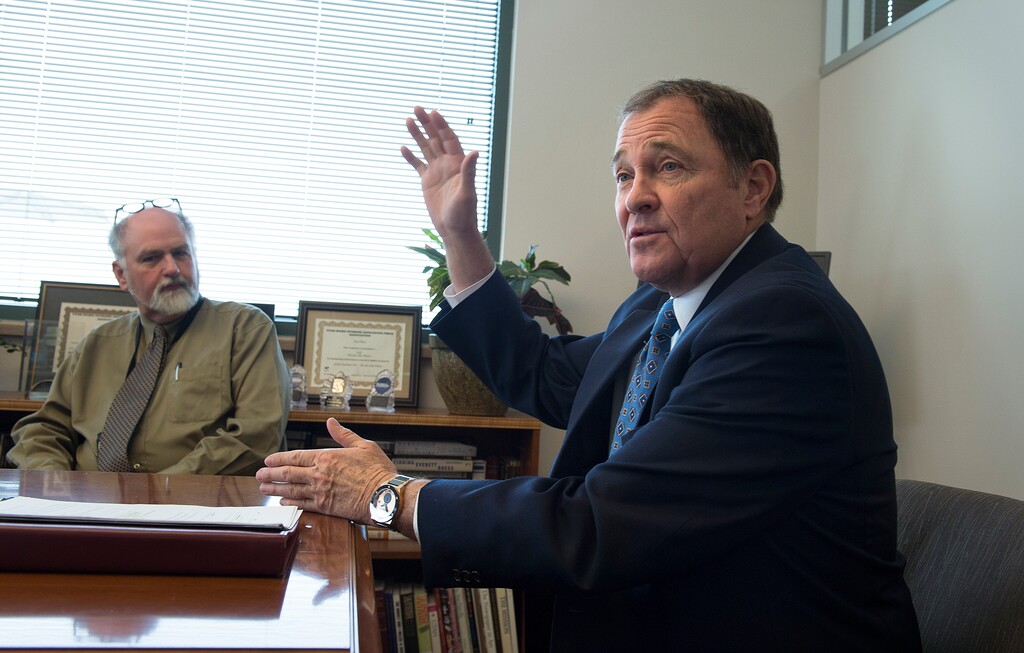
George Pyle (Tribune, Dec. 17) commiserated over Gov. Gary Herbert’s question of what philosophers do, retorting with a shrug: “You want fries with that?” Herbert had listed all the well-justified reasons for training a workforce to enrich the state’s economy. (Philosopher joke: “What happens when you ask a philosopher to change a light bulb?” Answer: “What do you mean by ‘change’”?) All this is completely inconsistent with Herbert’s practical — and true — take on education; skill in the workplace means money for both the worker and the employer.
My take on this is different. It boils down to “thinking: fast and slow,” as in the book by Daniel Kahneman. Fast thinking, exemplified by Herbert and Pyle’s response, makes the world go round as craftsmen do their thing, whether an auto mechanic or a surgeon, but “slow thinking” like deciding to bomb North Korea, entails critical analysis of the pluses and minuses: a pending danger or forging a bigger one like nuclear war. Or, as the auto mechanic confronts a tang in the motor or a surgeon a bile duct anomaly in gall bladder surgery, by engaging higher order knowledge beyond fast thinking to analyze and solve complicated problems. Studying skills of analysis is one thing philosophers do. That’s foundational work. They study how mistakes are made and how successful results are happily achieved with minimal or no mistakes by slow, rational thinking.
Herbert may have a bias about education: the value of liberal education, including philosophy. The extreme of this fallacious bias is equating the “theory” of Genesis in the Bible to the “theory” of evolution. They are not the same, as one is theology and the other proven science.
Richard H. Keller, M.D., Salt Lake City